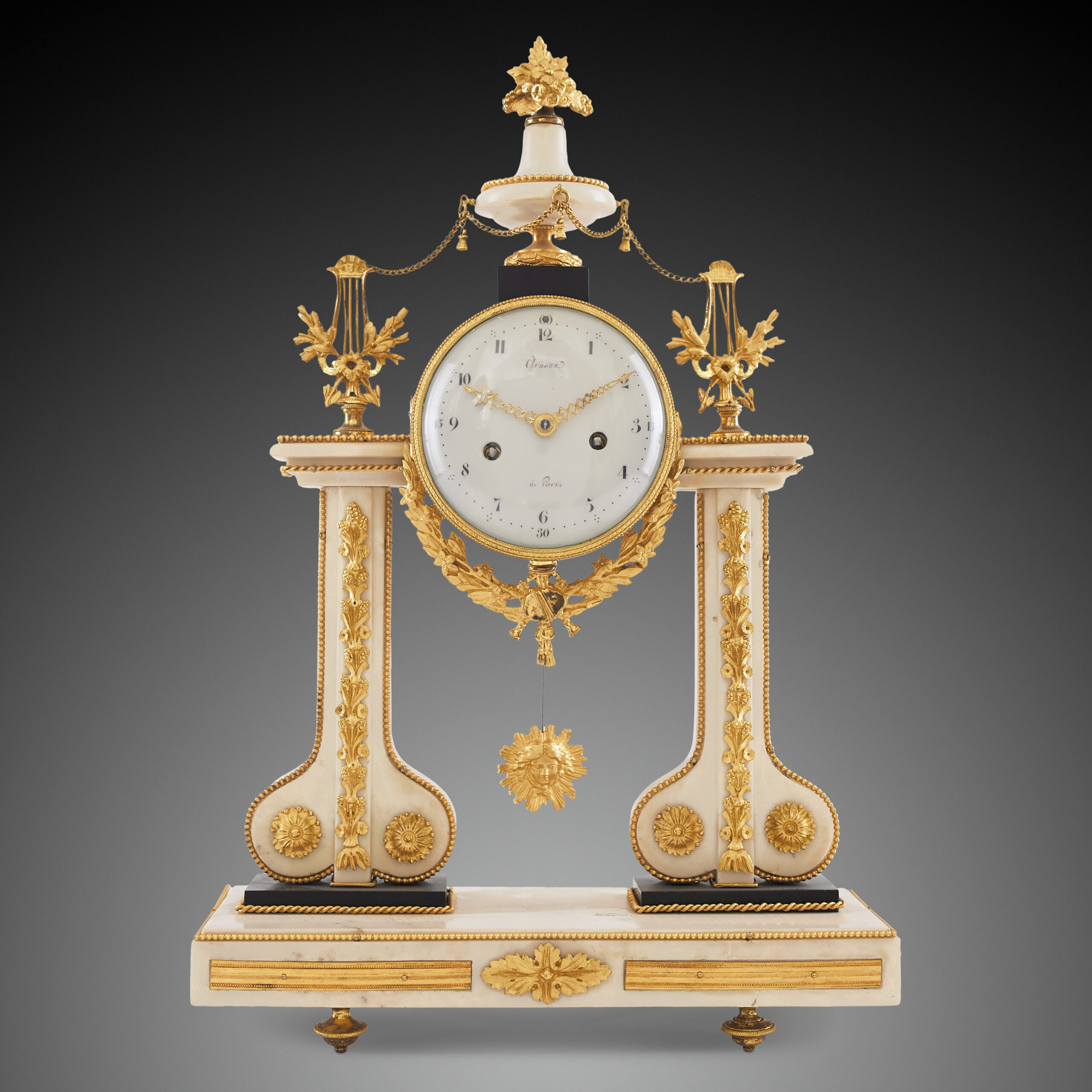
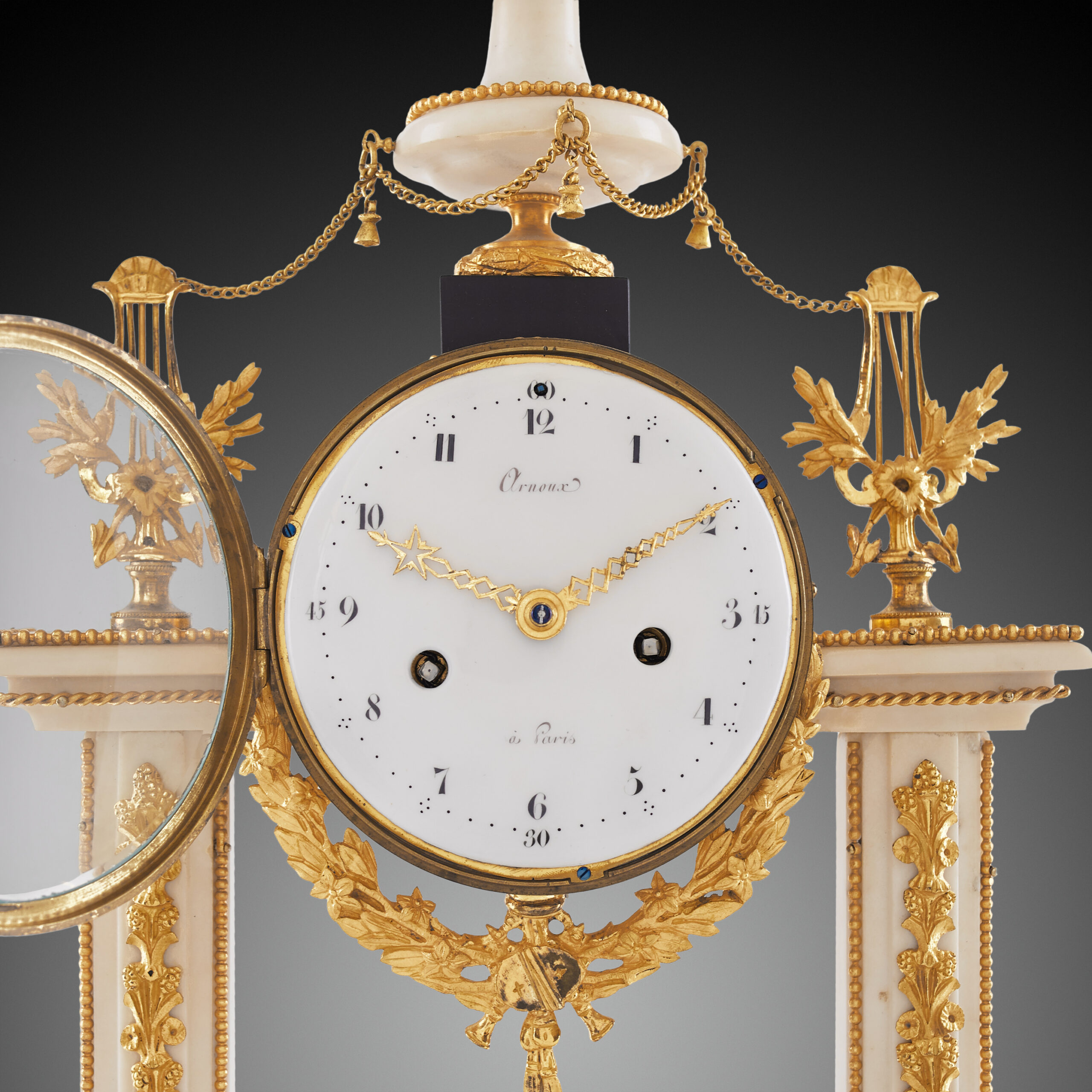
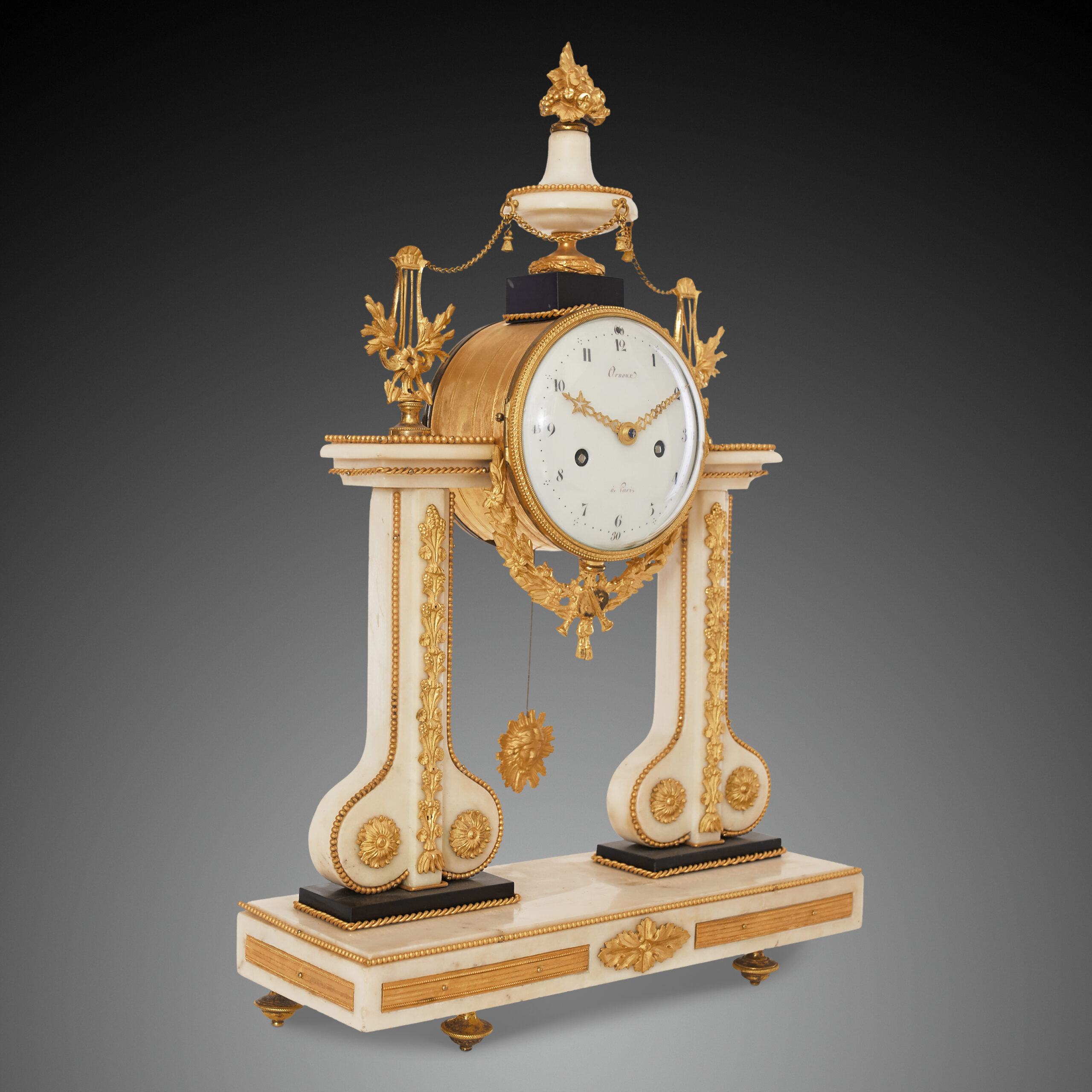
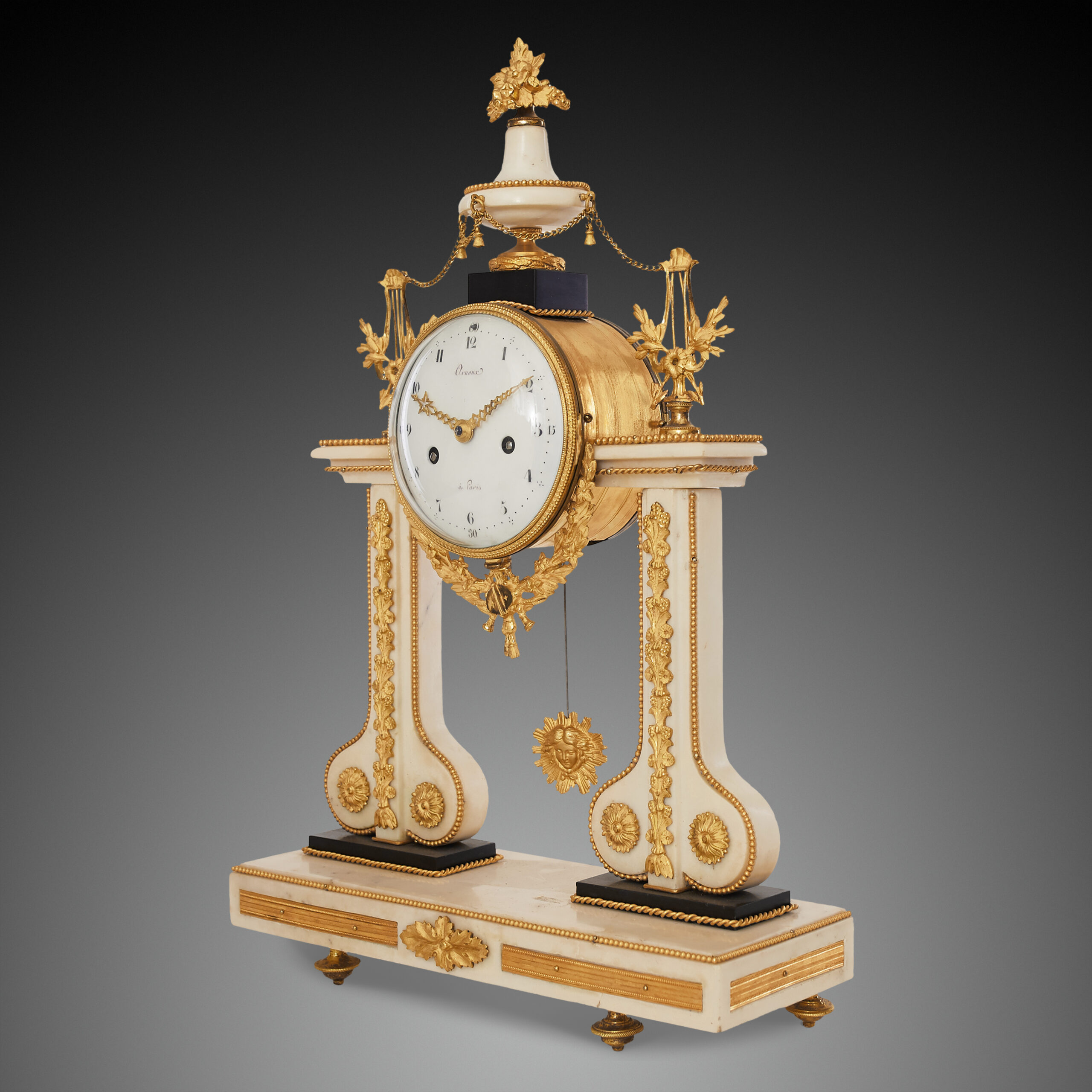
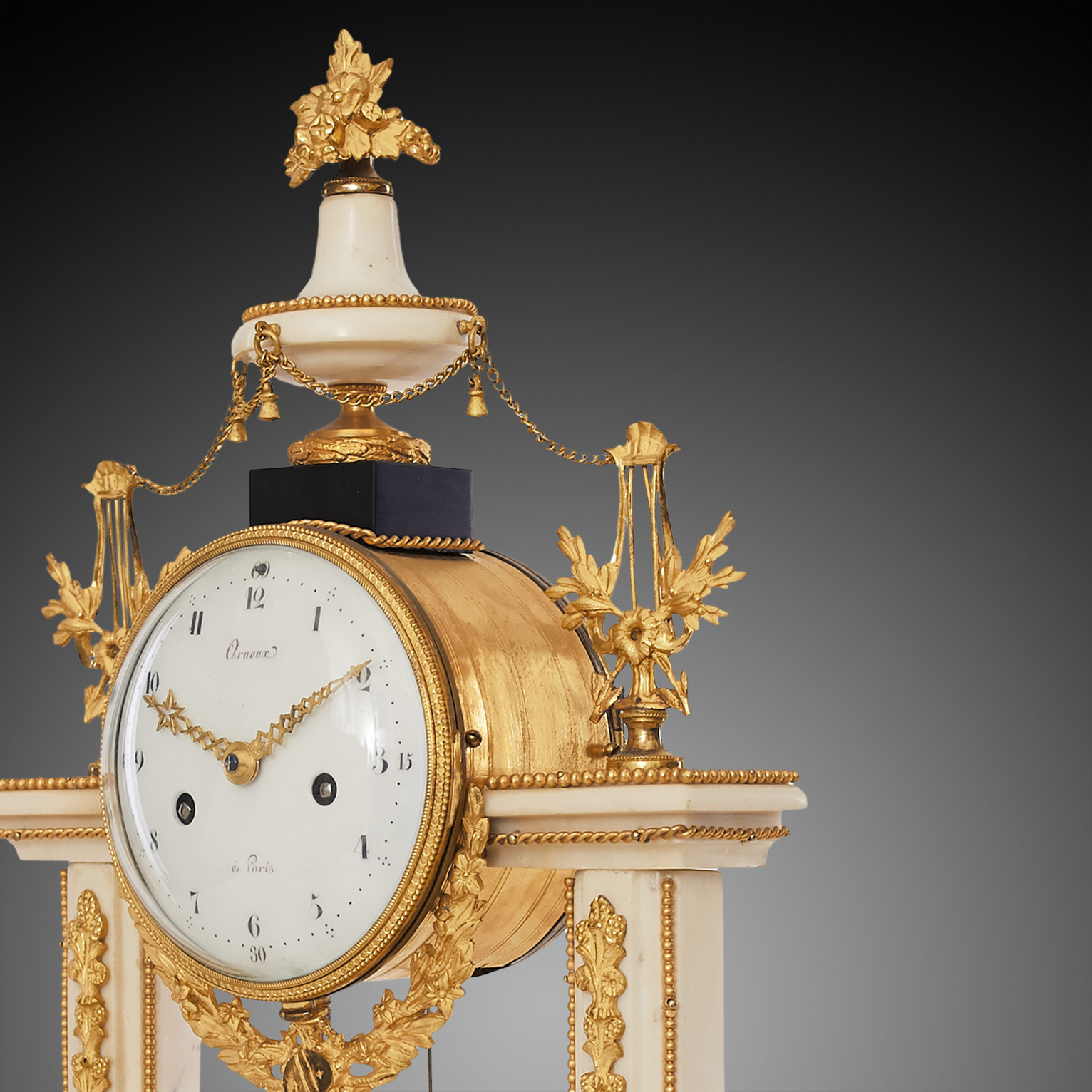
This elegant portico clock crafted in transitional Louis XVI – Empire style from ormolu, white and black marble, is signed on the dial “Arnoux à Paris”. Decorative motifs of Louis XVI style were inspired by nature and antiquity with characteristic elements which would reoccur in many goods that were created in that period. The use of gilt-bronze has reached its peak at the beginning of the 19th century in France, as it was cheaper than gold or silver. For this reason, it became the favourite material for clock cases, ornamental elements, candelabra and furniture ornaments. Bronze was the main material used in Empire style timepieces and both the patina and ormolu techniques were vastly used for ornamentation during this period. Most clock cases in the 19th century were cast in bronze and others combined with a stone base made of marble, alabaster or porphyry. However, thanks to the skill of remarkable bronze casters and chasers these objects were not merely timekeepers but became objets d’art.
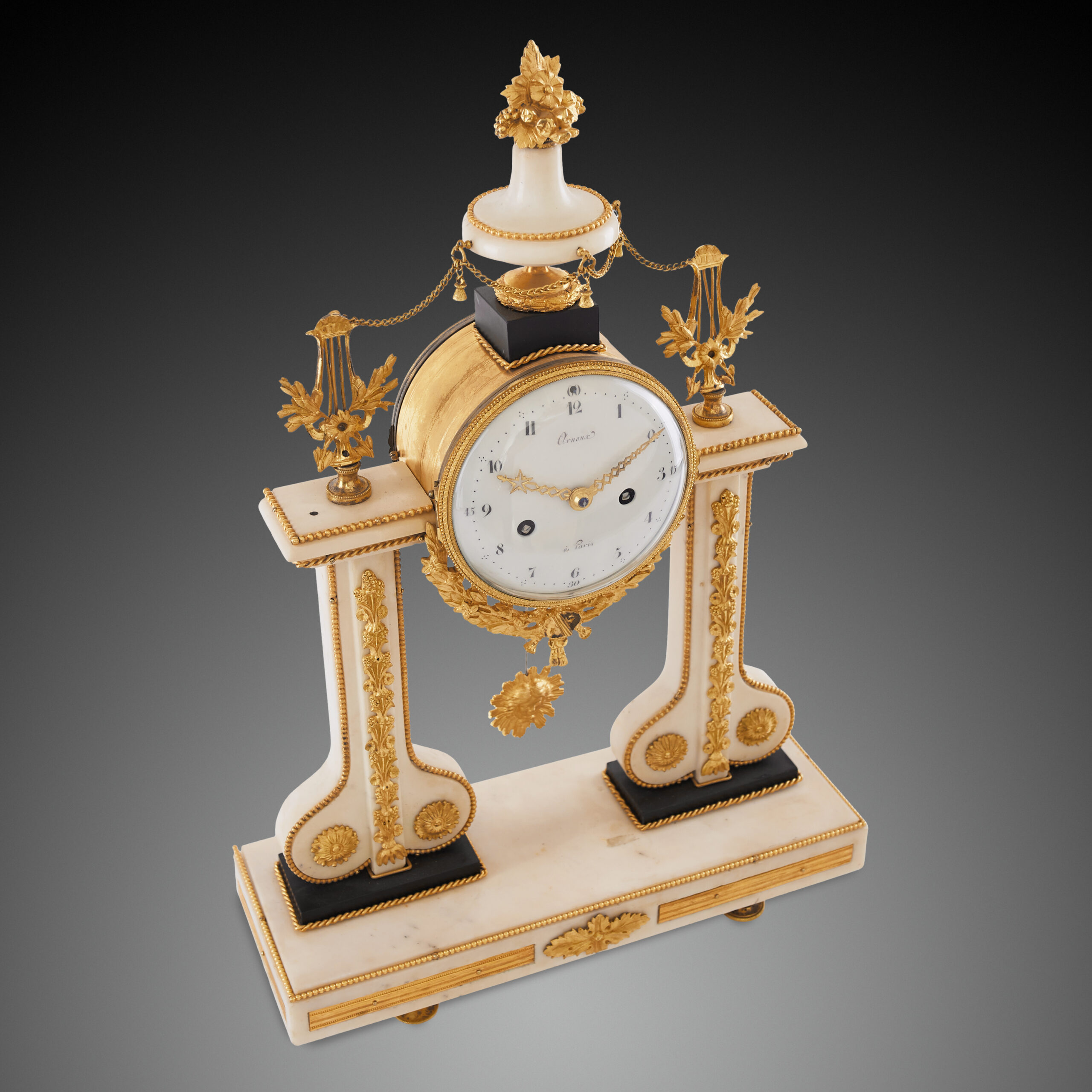
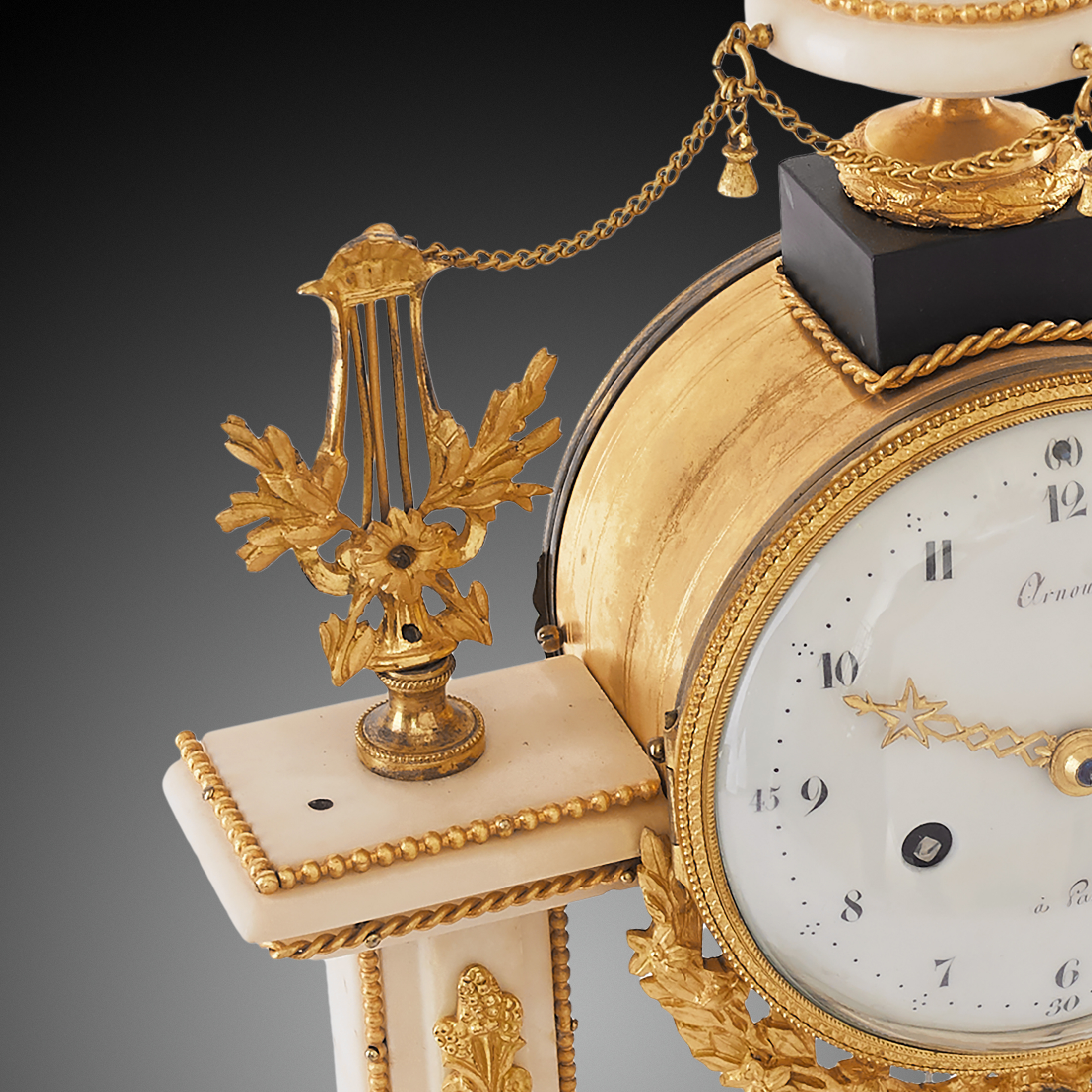
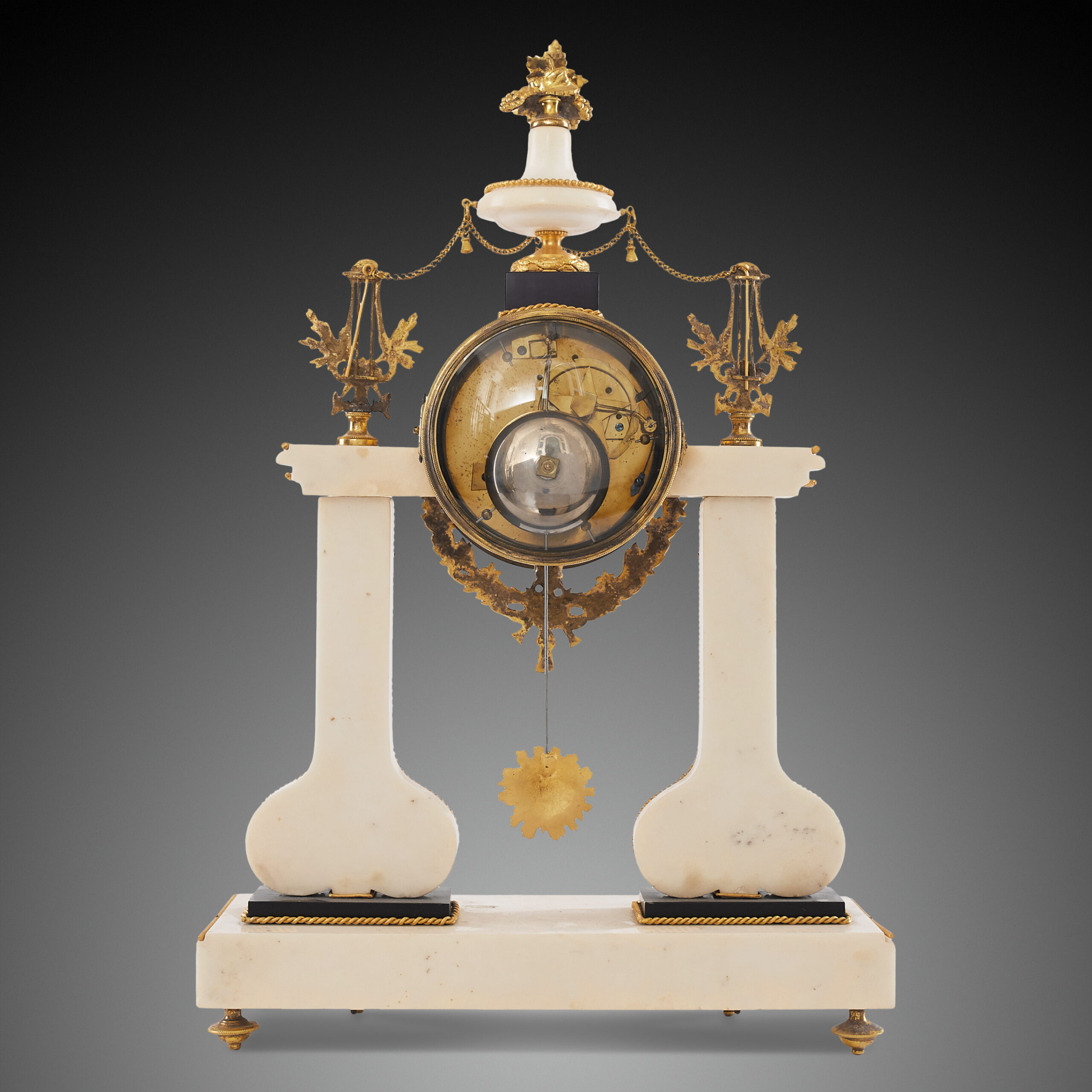
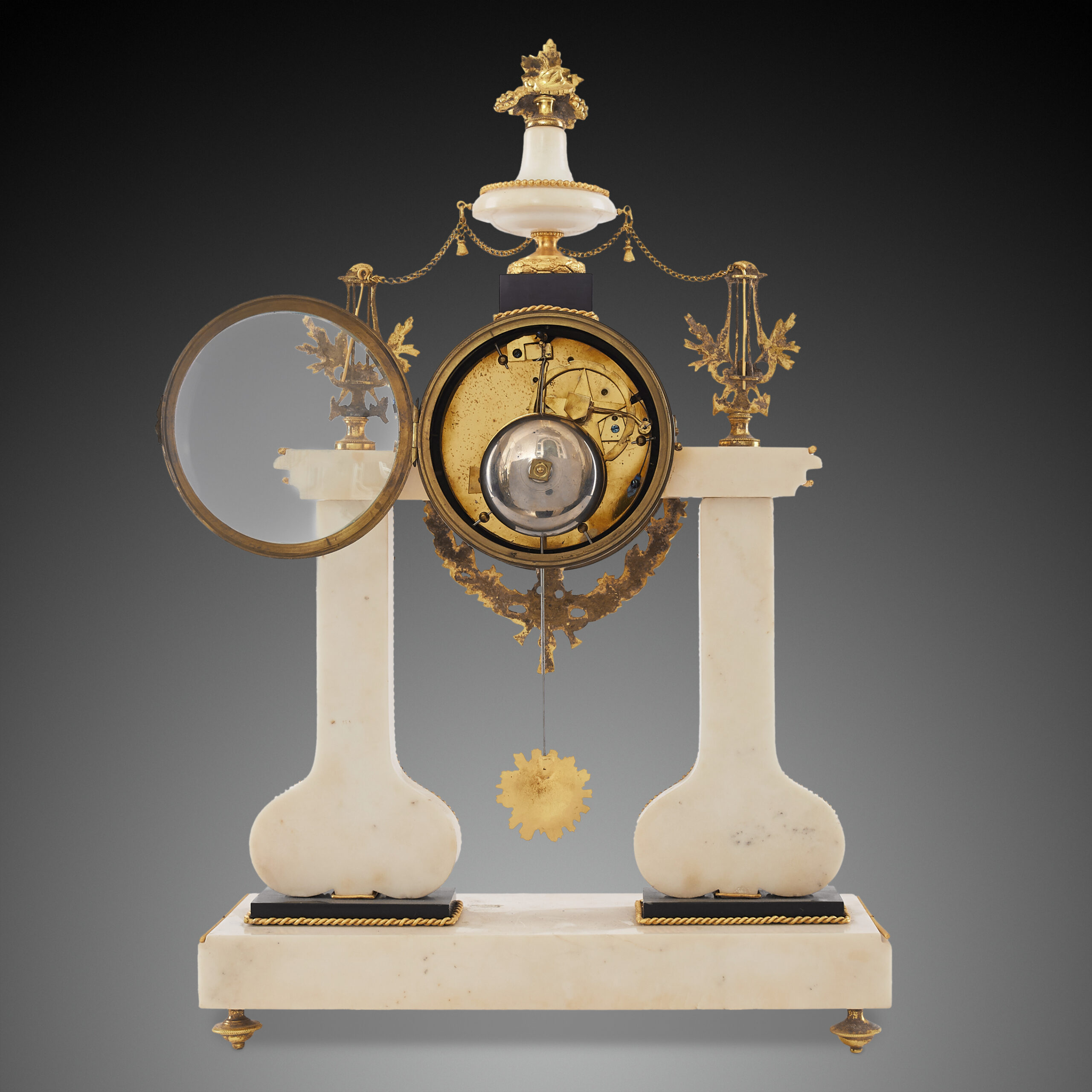
This very rare marble portico clock is composed of two marble columns with the lower part of the column curving into an oval shape and resting on top of a black rectangular marble base. The front edges of the column are adorned with ormolu beaded framing, and in the centre of the column is a long moulding of a garland with a flower motif, at the curved bottom of the column rests two ormolu rosettes. The cornice of the columns are also decorated with ormolu beading lines and above the cornice on both sides of the columns are resting gilded lyras crossed with an arrow made from a stem with leaves and a flower.
The space between the columns is occupied by the cylinder-shaped dial. At the top, a flower vase and a basin made from marble and gilded bronze surmount the dial. Moreover, the marble basin is connected with lyras resting on the columns with delicate gold chains and small bell-shaped elements.
The large domed enamel dial is accompanied by finely worked gilded hands and uses Arabic numerals to indicate hours and minutes, including 8-day movement that strikes hours and halves on a bell, all protected by curved glass. Beneath the dial hangs a decorative element crafted from gilded bronze in the shape of a laurel wreath with flowers and crossed daggers in the middle, further down is a sun king pendulum, which can be interpreted as the king is the most important person in the nation just like the sun is in the most important in the solar system.
The terrace with steps of white marble is adorned with gilded bronze friezes and in its centre is a bronze mount in an acanthus motif. It rests on four small finely gilded toupie feet.
The portico clocks were invented in the Louis XVI periods, along with considerably more of other models. The portico model was a huge success, which is why they come in a wide variety of designs and colours, but their main structure always consists of a base, two columns or two pilasters, an entablature and a dial in the centre of the entablature. The concept is mostly connected with the architecture of Greek and Roman temples.
LITERATURE
Pierre Kjellberg, “La Pendule Française du Moyen Age au XXe Siècle”, 1997, p. 197-199