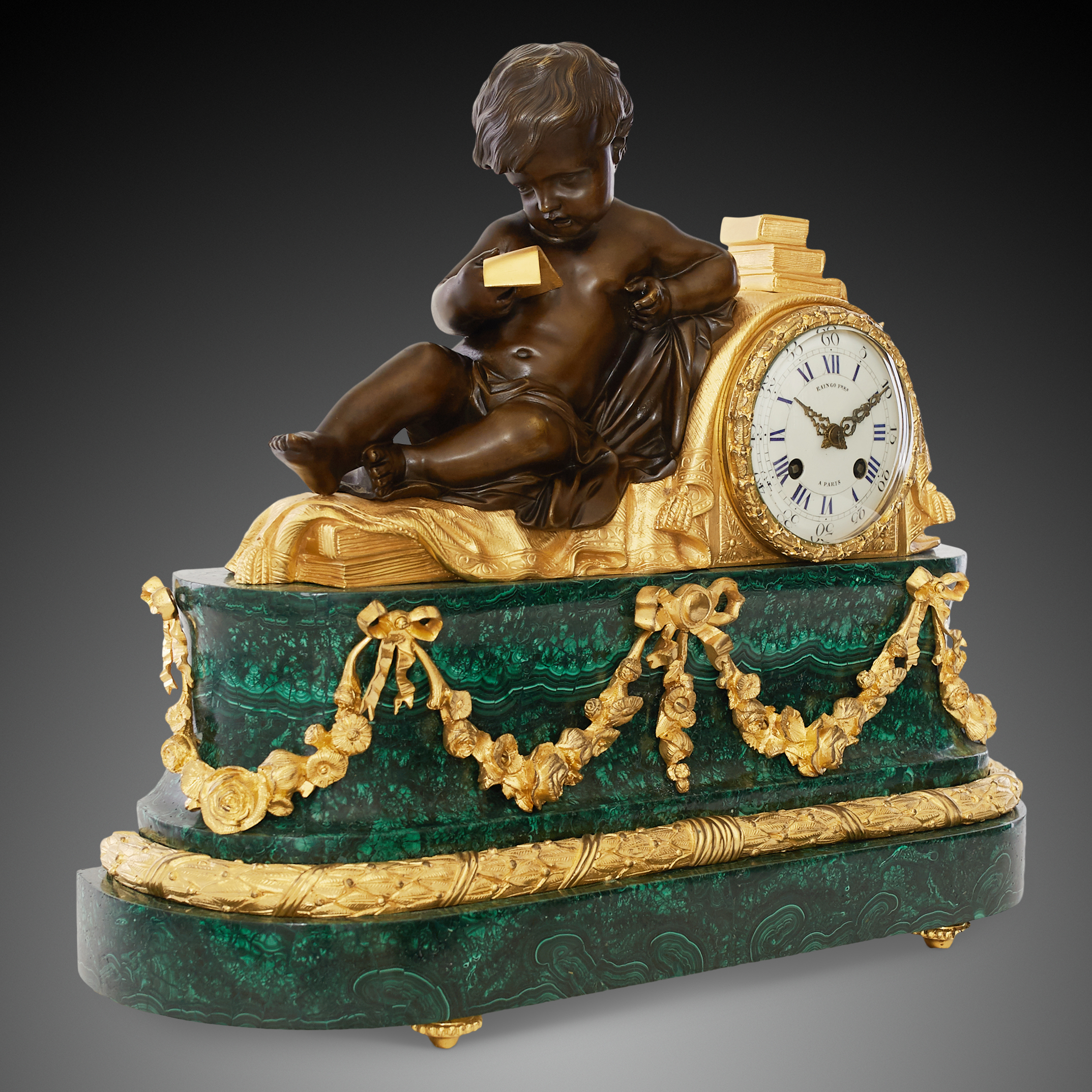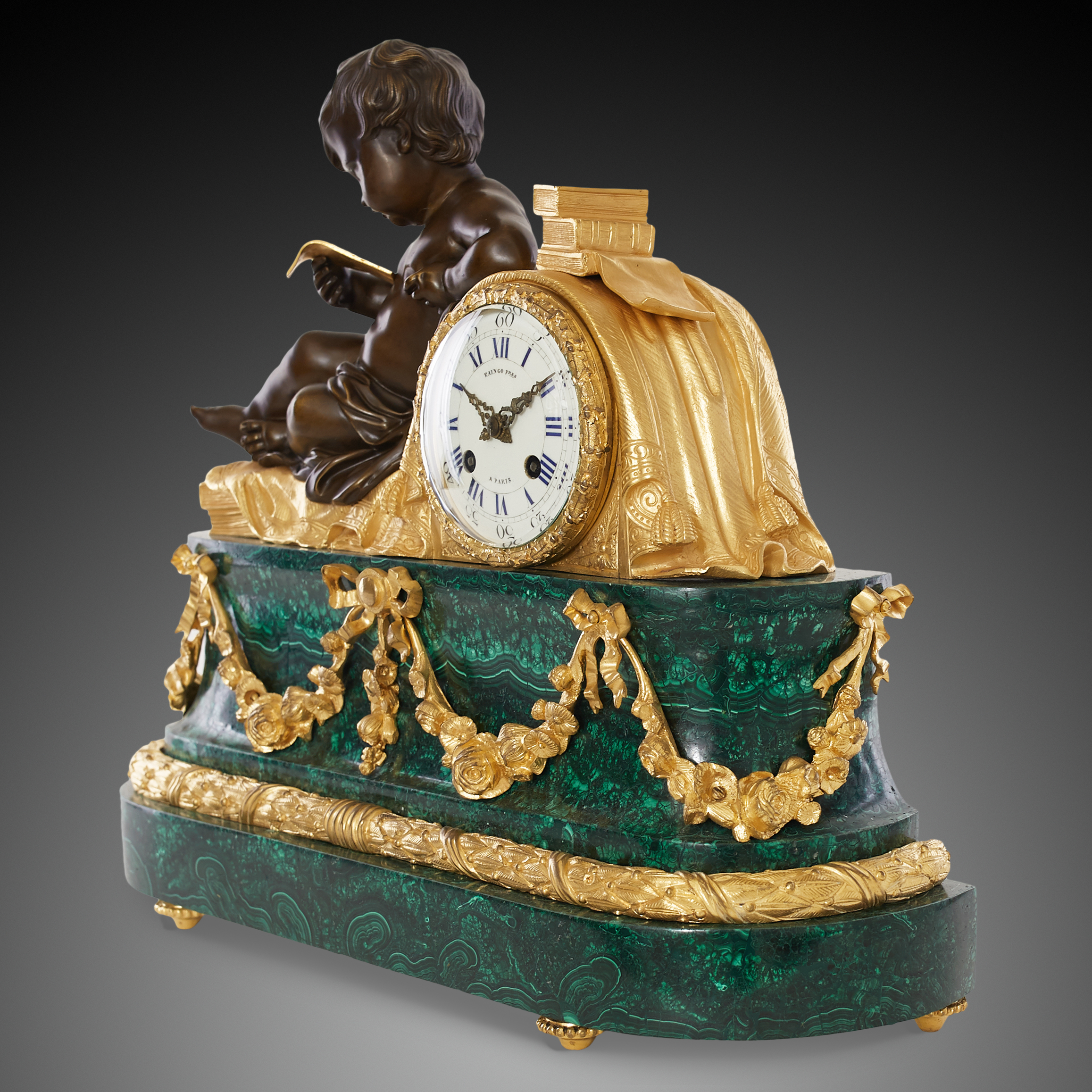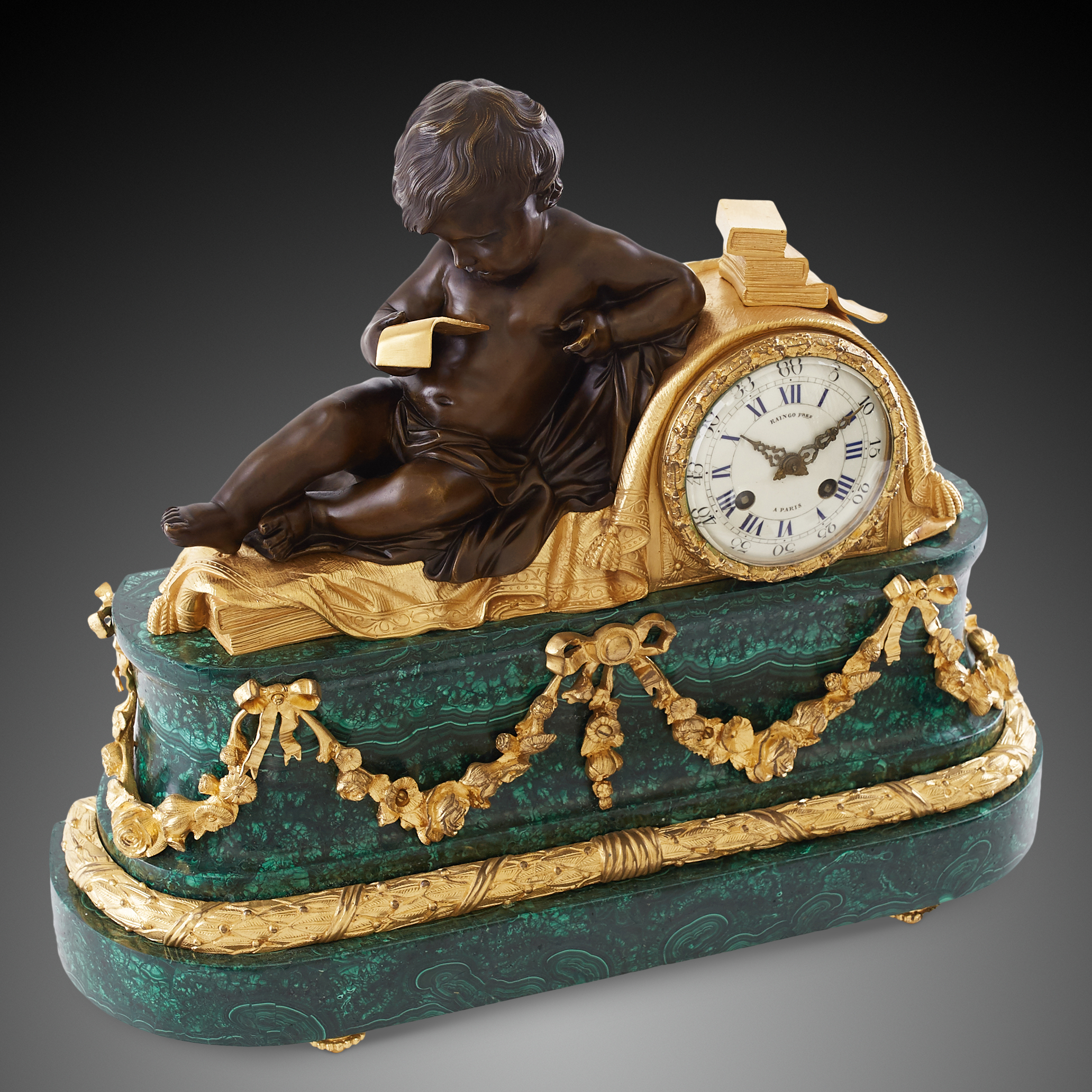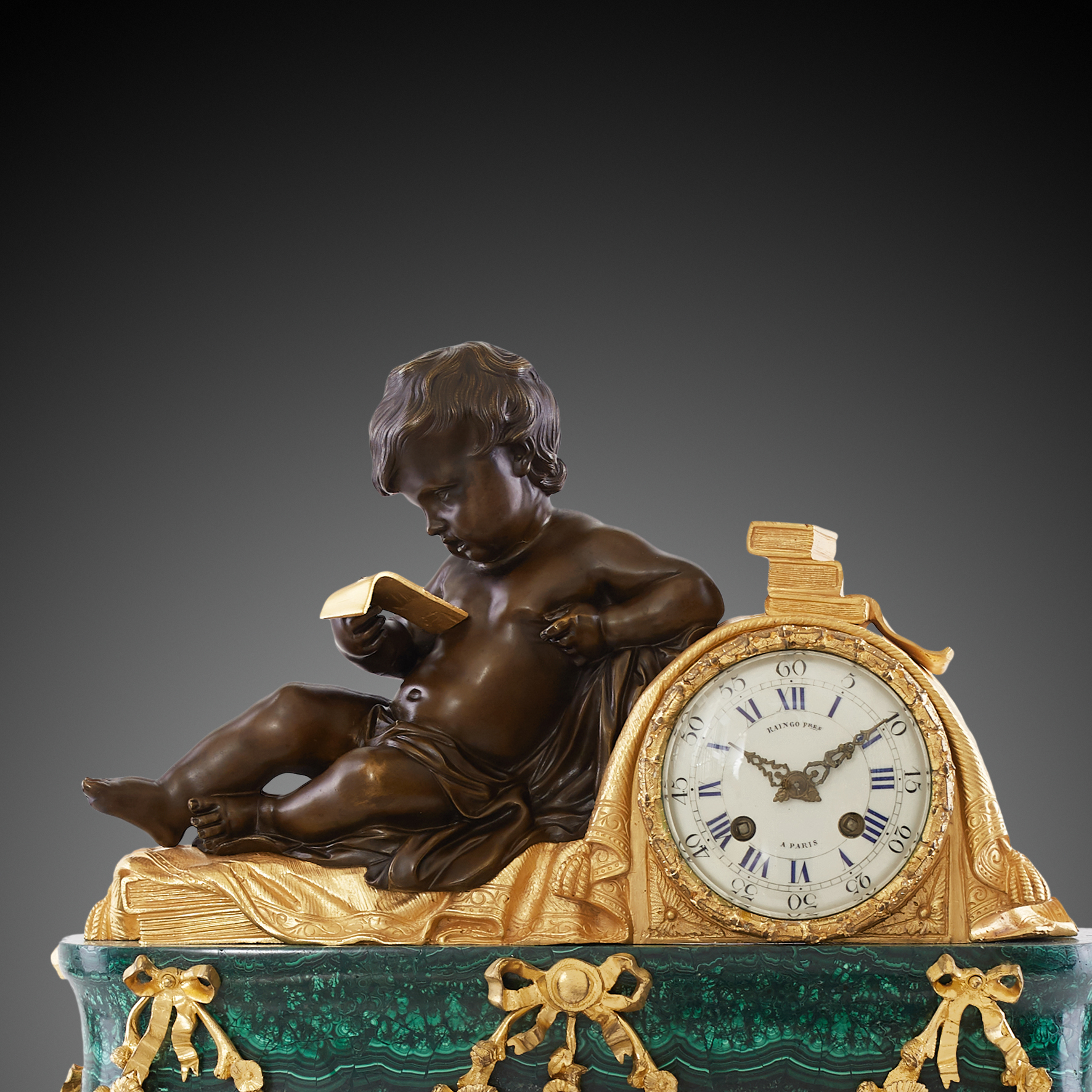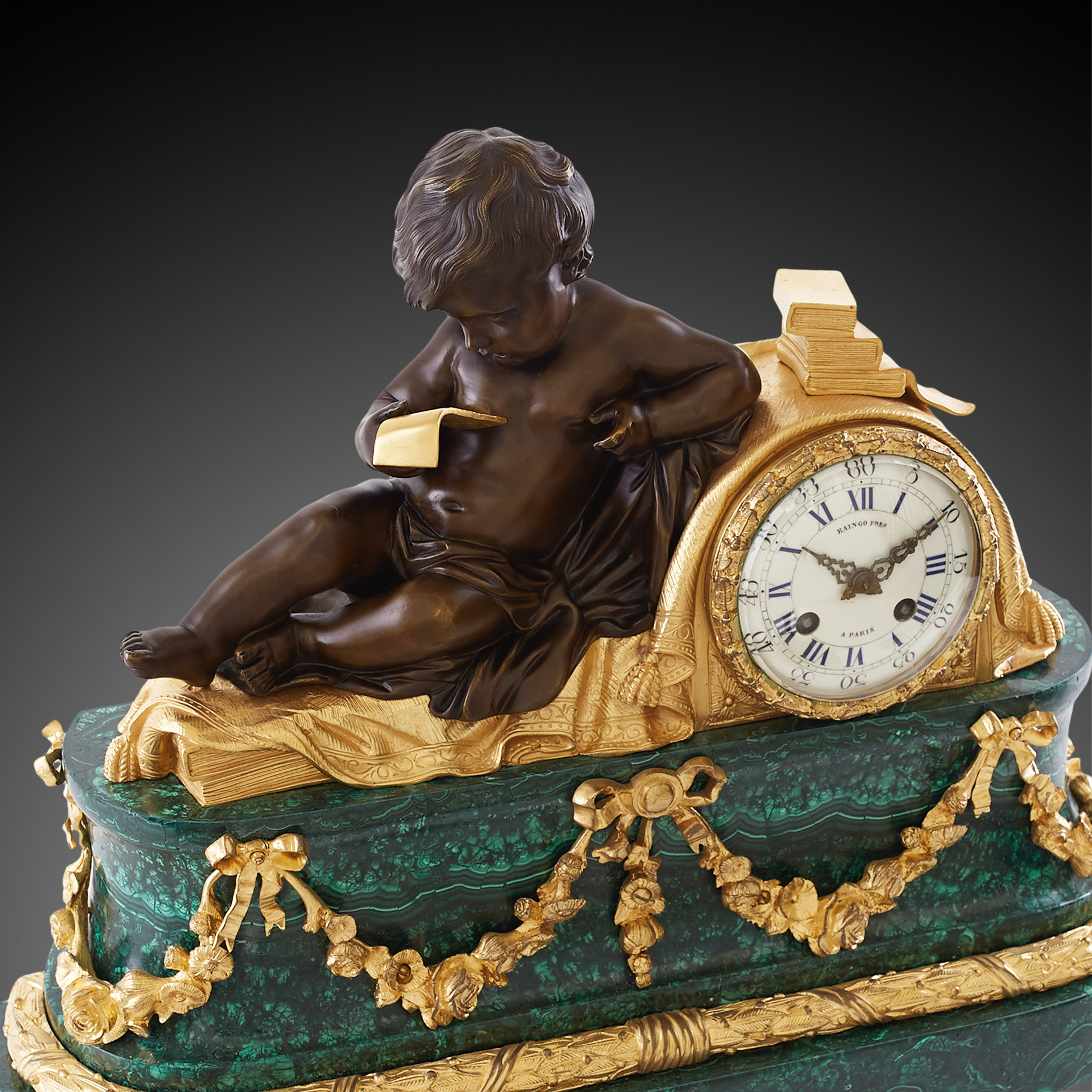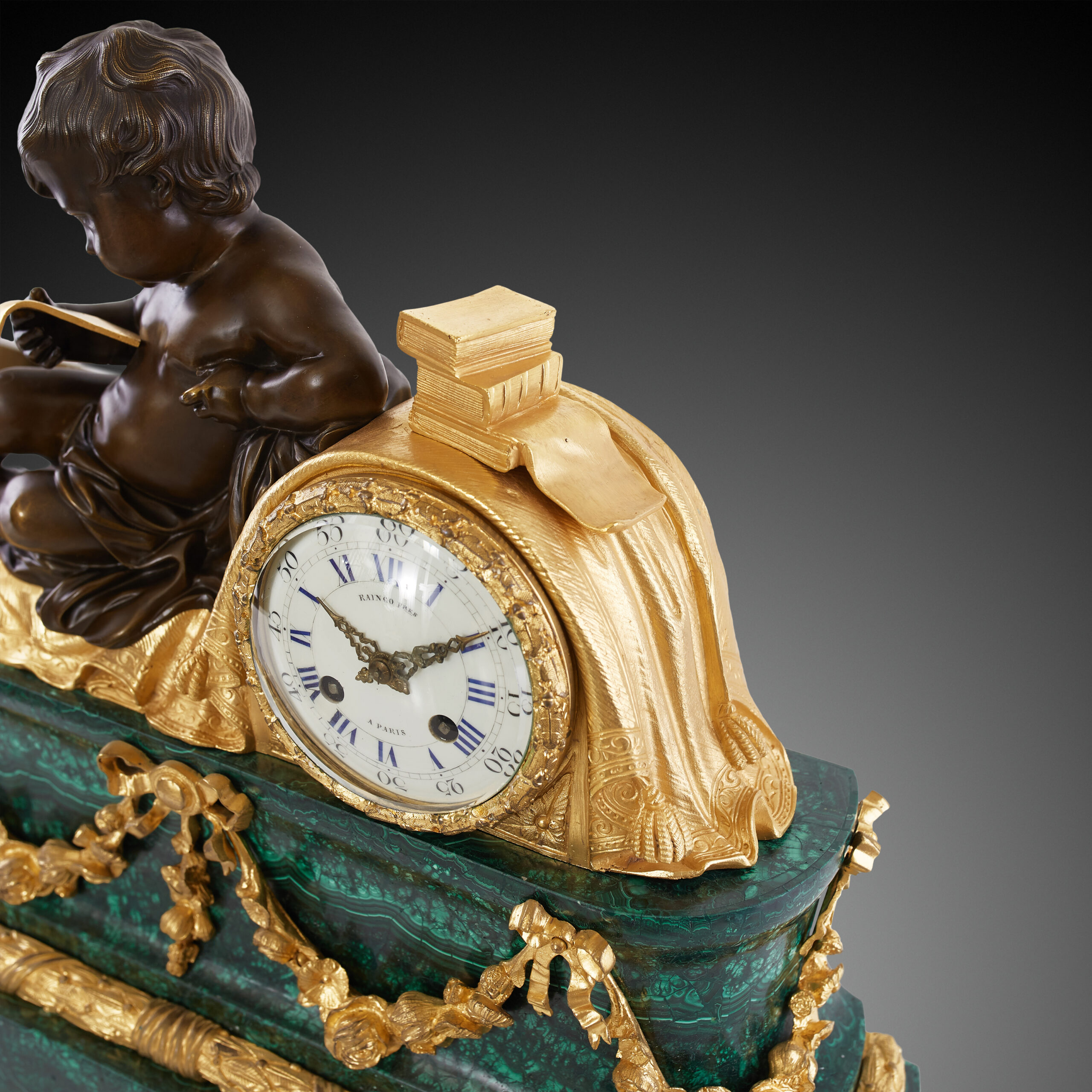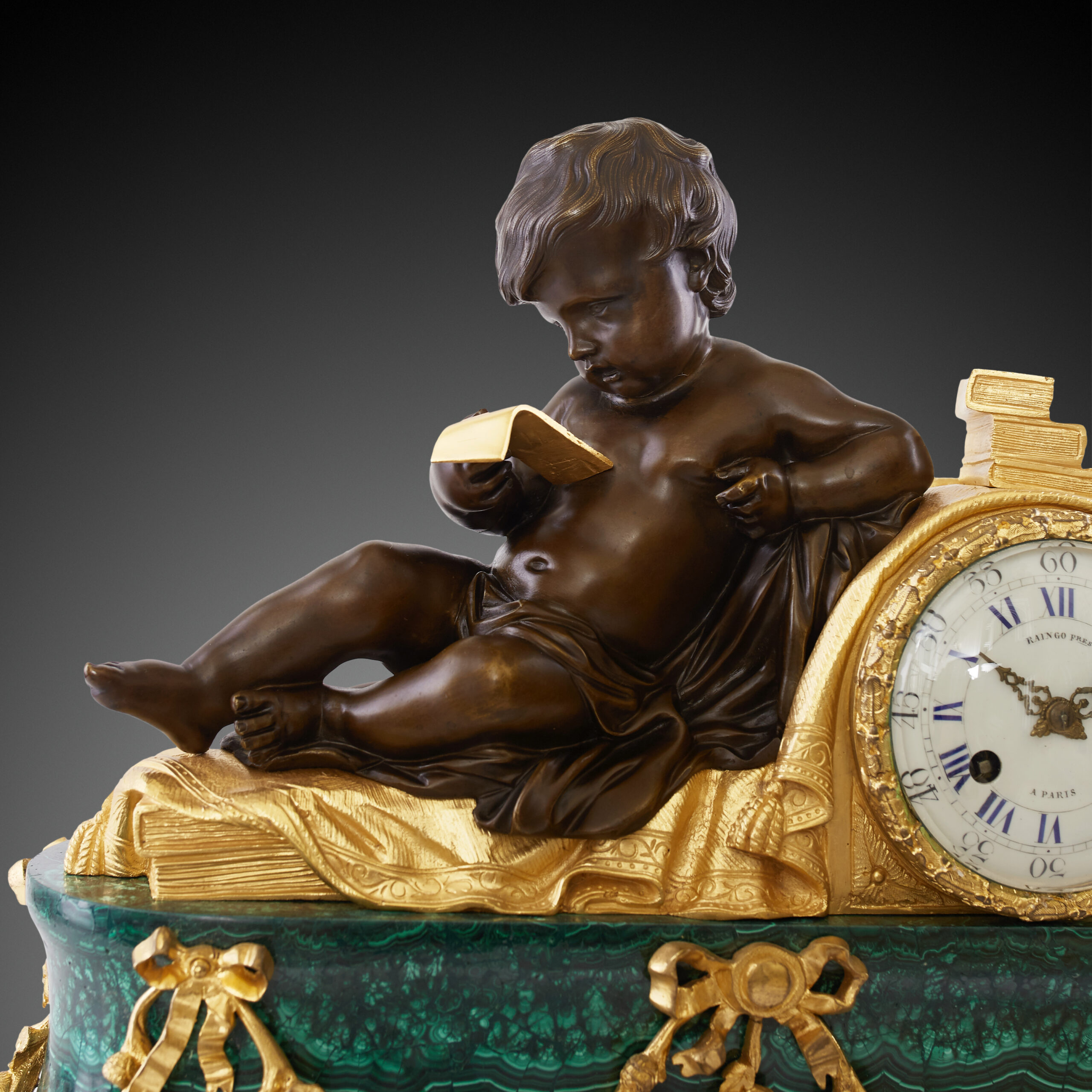
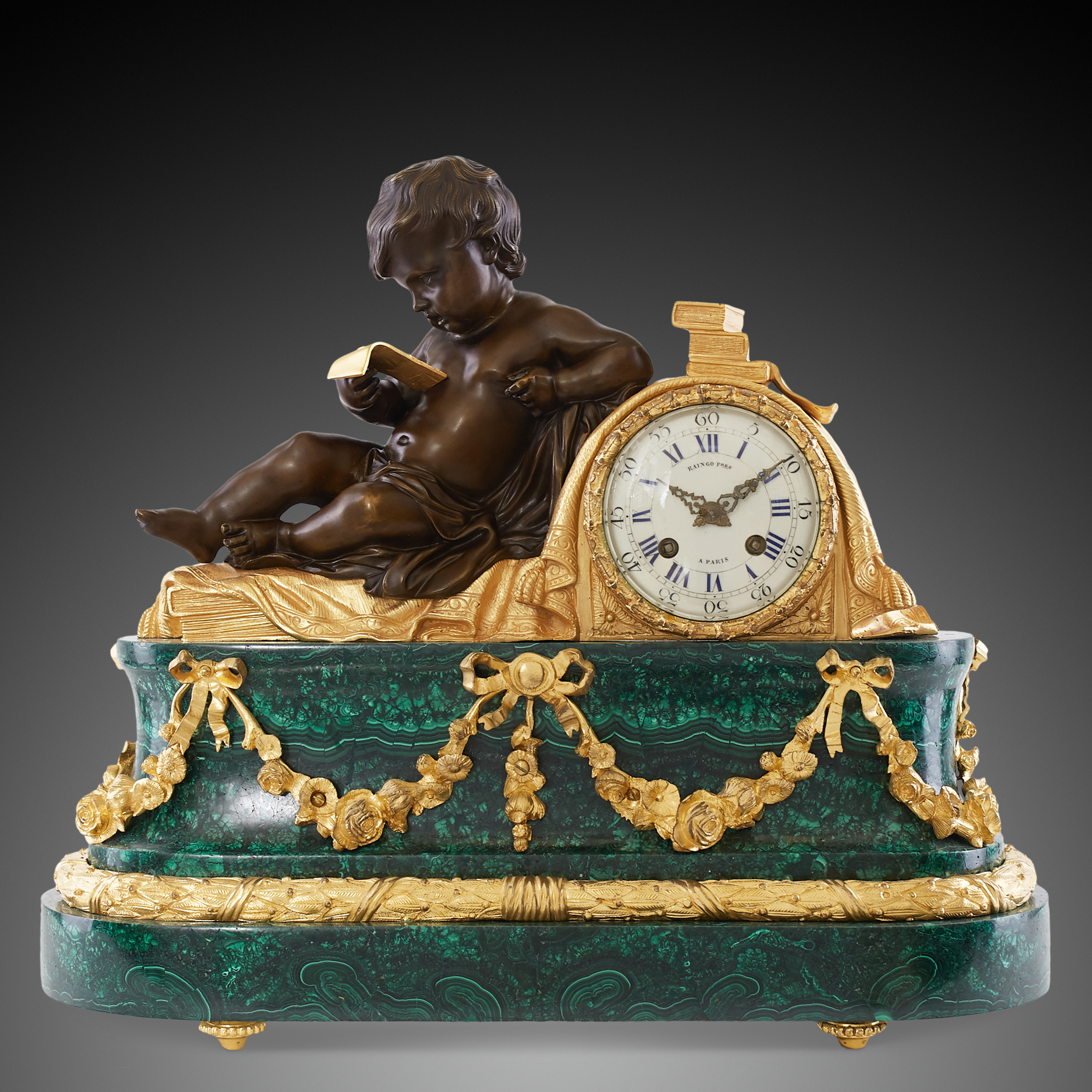
The Raingo Frères mantel clock is a definitive expression of mid 19th century French luxury, serving as a masterful study in contrast and narrative by harmonizing the deep, swirling intensity of Russian malachite with the warm, brilliant luster of mercury gilded bronze. The figure of a seated putto, rendered in rich patinated bronze, is captured in a moment of quiet intellectual repose as he studies a book, a motif that elevates the clock from a mere timekeeper into a sculptural celebration of learning and leisure. This specific iconographic choice reflects the Enlightenment values that continued to permeate the French decorative arts long after the 18th century, suggesting that the passage of time should be accompanied by the pursuit of knowledge.
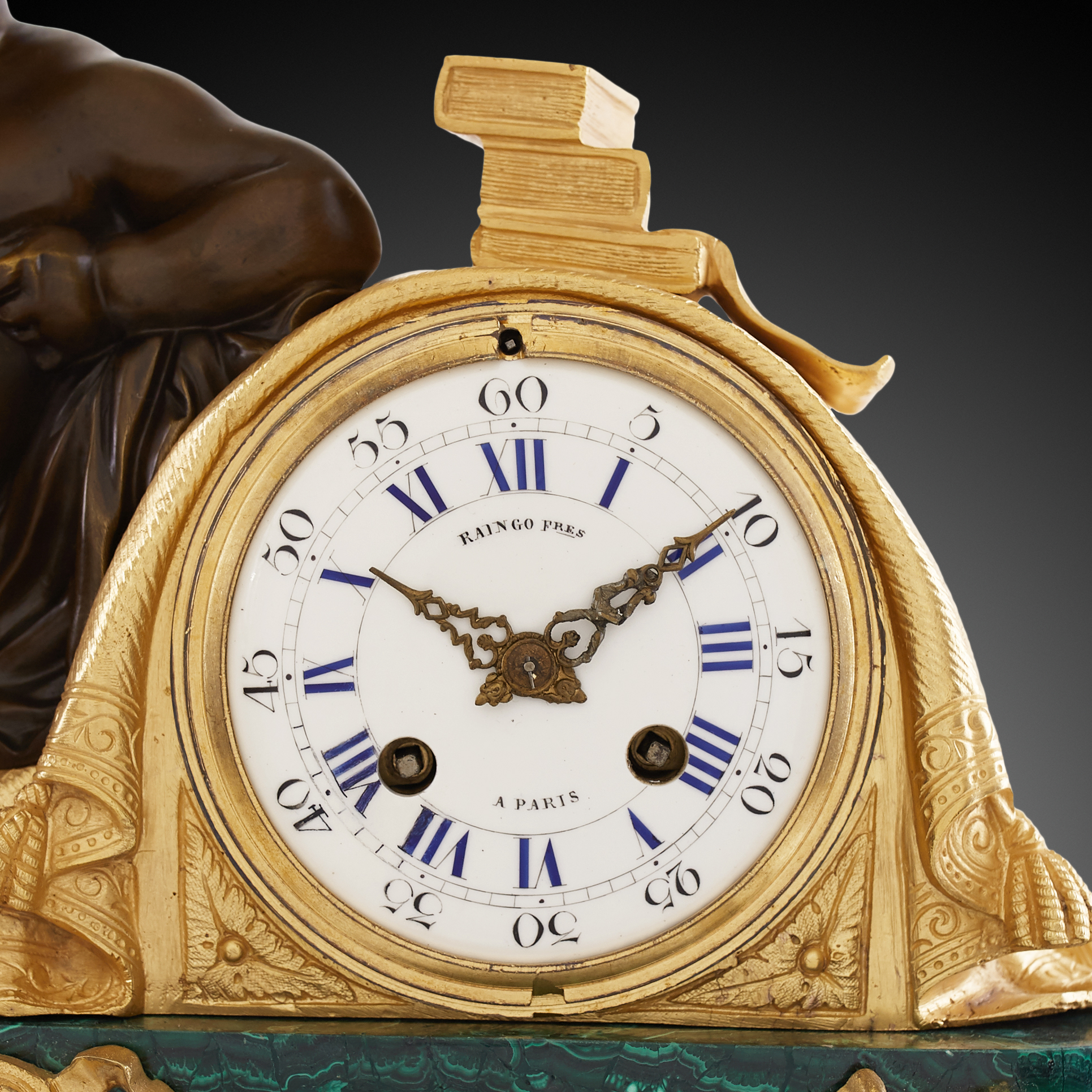
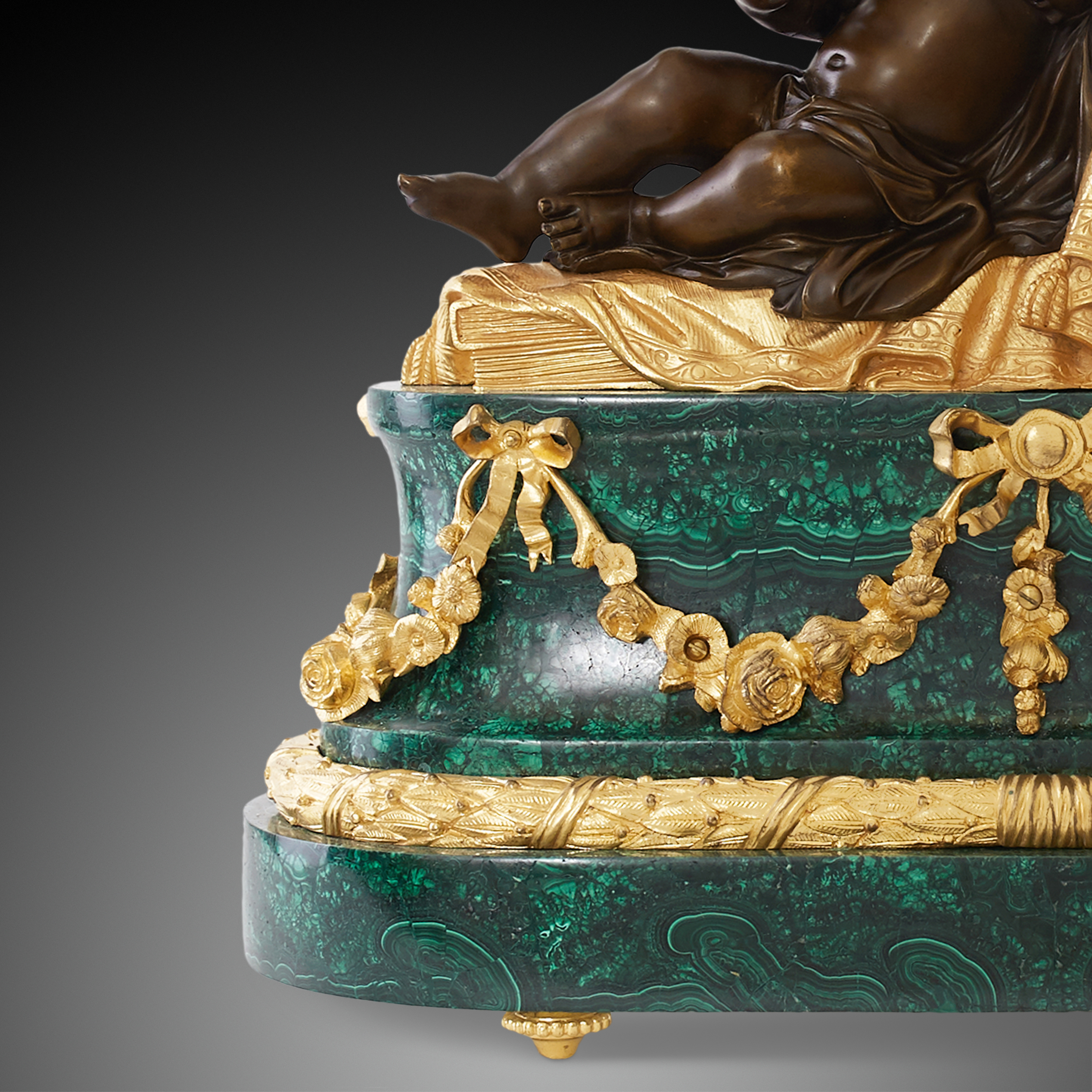
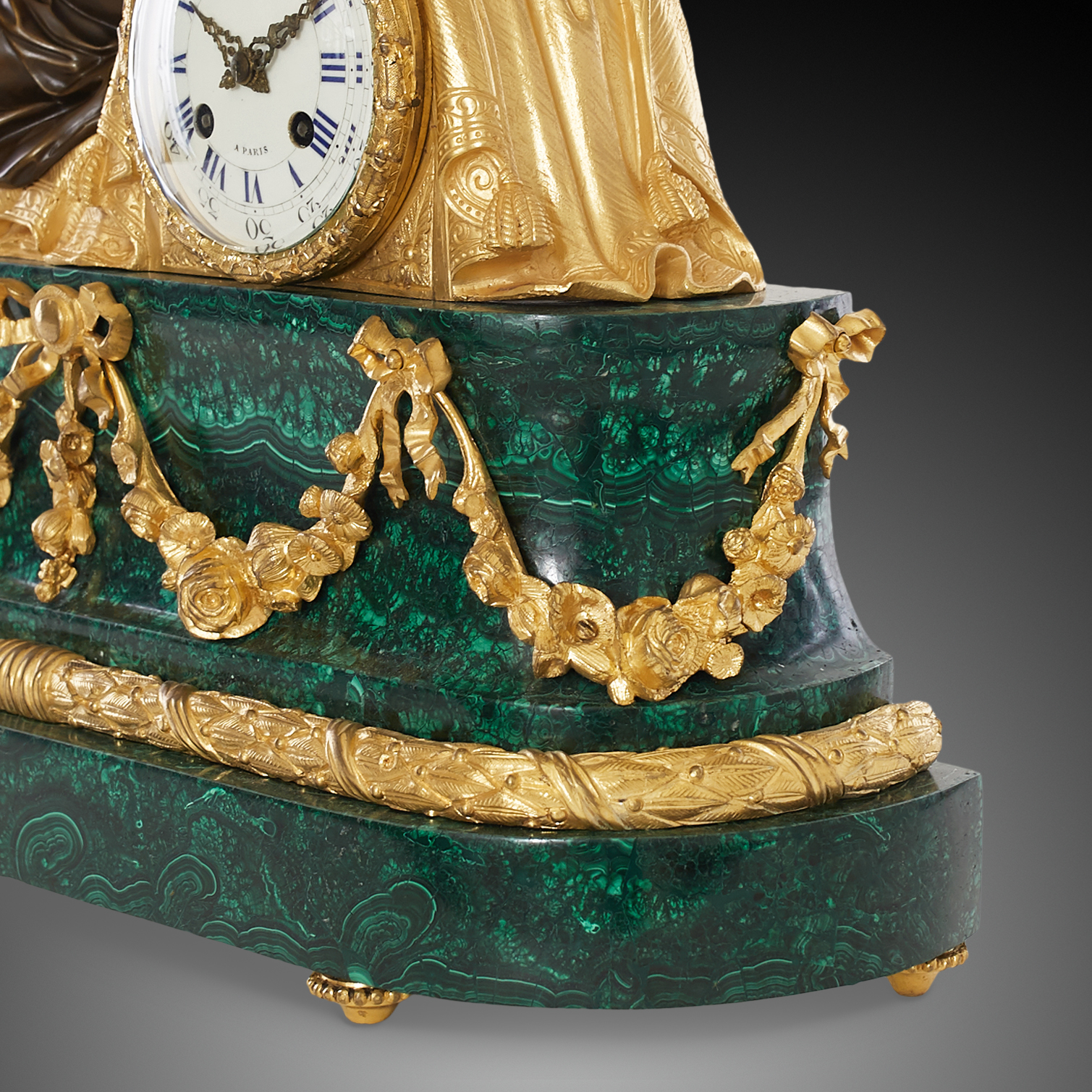
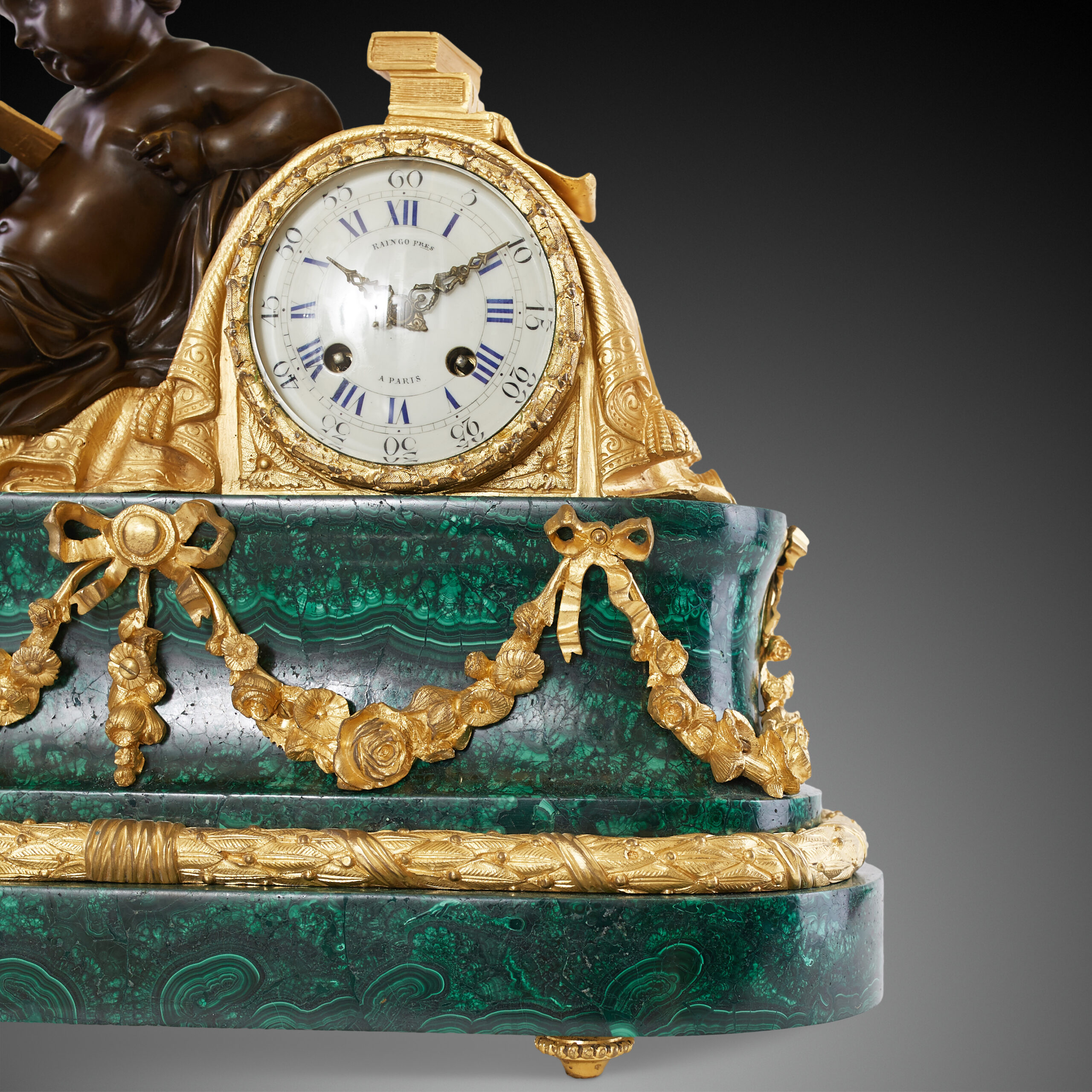
The architectural foundation of the clock, composed of a luxurious malachite plinth, is adorned with finely chased ormolu garlands and floral motifs. This specific use of swags tied with ribbons is a deliberate nod to the refined classicism of the Louis XVI period, yet the execution displays the enhanced, bold sensibility of the Napoleon III era. Every metal element, from the delicate Roman and Arabic numerals on the white enamel dial to the intricately pierced hands and the hidden toupie feet, reflects the firm’s legendary commitment to craftsmanship. The choice of malachite is particularly significant in a historical context, as the mineral became a hallmark of Imperial Russian diplomacy. Following the discovery of massive deposits in the Ural Mountains, the Russian Tsars frequently gifted malachite objects to European monarchs, eventually leading to a craze among the Parisian elite who viewed the stone as the ultimate material for high status interior decoration.
The history of Raingo Frères is itself a testament to the heights of European horology. Founded by Zacharie Joseph Raingo, a specialist in complex astronomical movements, the firm evolved into a powerhouse of Parisian luxury. Zacharie Joseph’s early career in Belgium and his subsequent move to Paris in 1813 marked the beginning of a dynasty that would define French clockmaking for nearly a century. Their work was prized by royalty and heads of state, including King George IV of England, who famously acquired one of Zacharie’s planetary clocks for Windsor Castle, and Emperor Napoleon III and Empress Eugénie, whose own commissions now reside in the collection of the Musée du Louvre. By the mid 1800s, the four Raingo brothers-Adolphe, Charles, Denis, and Dorsant-had expanded the business into a full scale “maison de bronze,” allowing them to control every stage of production from the initial casting to the final gilding.
This clock carries that same pedigree; it is not simply an object, but a piece of history that reflects the firm’s collaborations with the greatest artists of their time, such as Albert-Ernest Carrier-Belleuse and François Linke. These collaborations were essential in maintaining the firm’s dominance at the Great Exhibitions, where they consistently won prestigious awards, including a gold medal at the 1889 Exposition Universelle. The ability of Raingo Frères to adapt the delicate proportions of the Ancien Régime to the more substantial and eclectic tastes of the late 19th century is what made them the preferred choice for the European aristocracy.
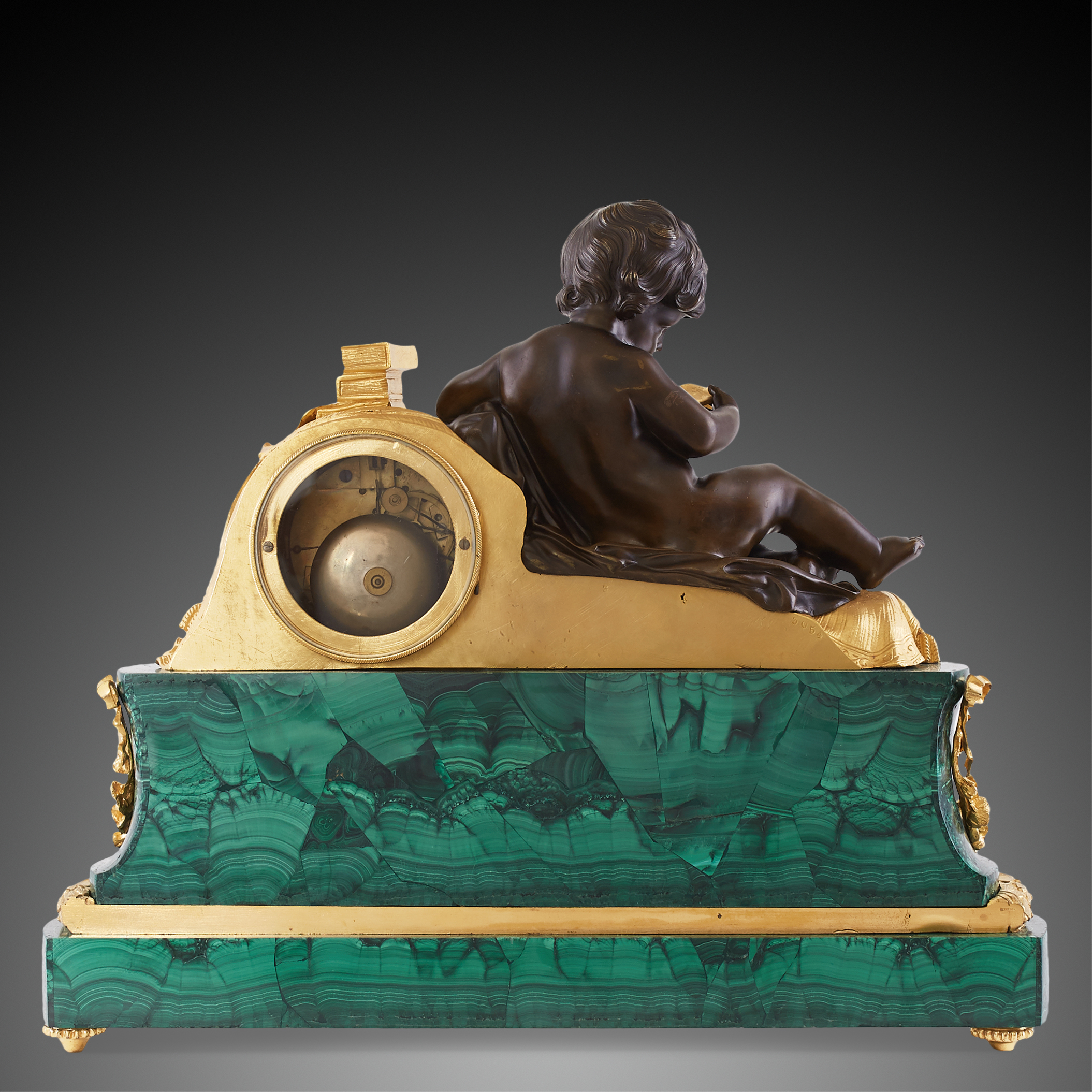
Mechanically, the clock is in exemplary condition. It has been meticulously cleaned and serviced by a specialist in museum grade horology to ensure its eight day movement continues to function with precision. It strikes the hour and half hour on a clear, resonant bell, providing an auditory experience that matches its visual beauty. Offered complete with its original pendulum, winding key, and bell, this piece remains fully functional and ready to serve as the centerpiece of a distinguished interior. It is a rare opportunity to own a work that embodies the perfection of 19th century French decorative arts, where the scientist’s precision met the artist’s hand to create a truly timeless legacy that continues to command respect in the modern era.