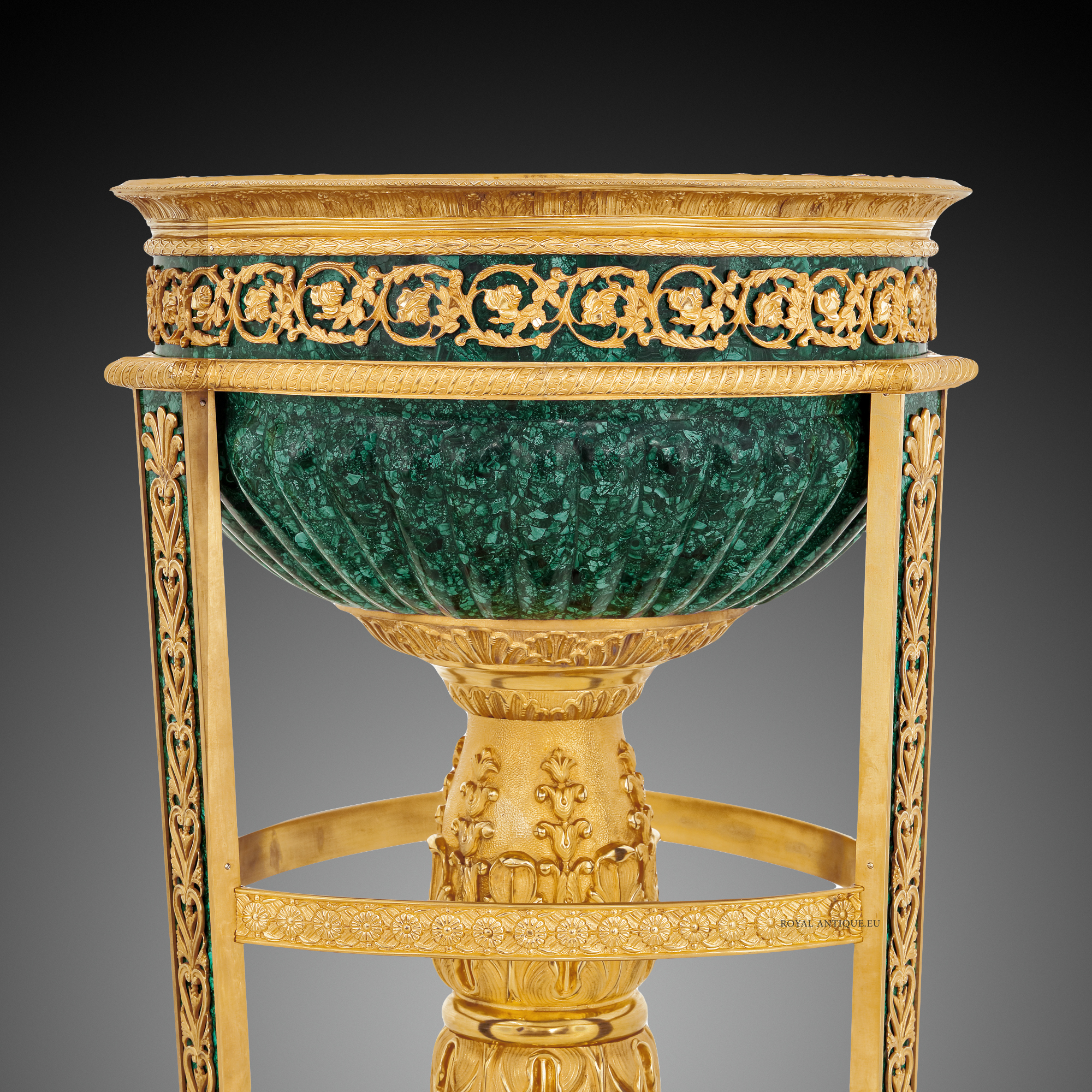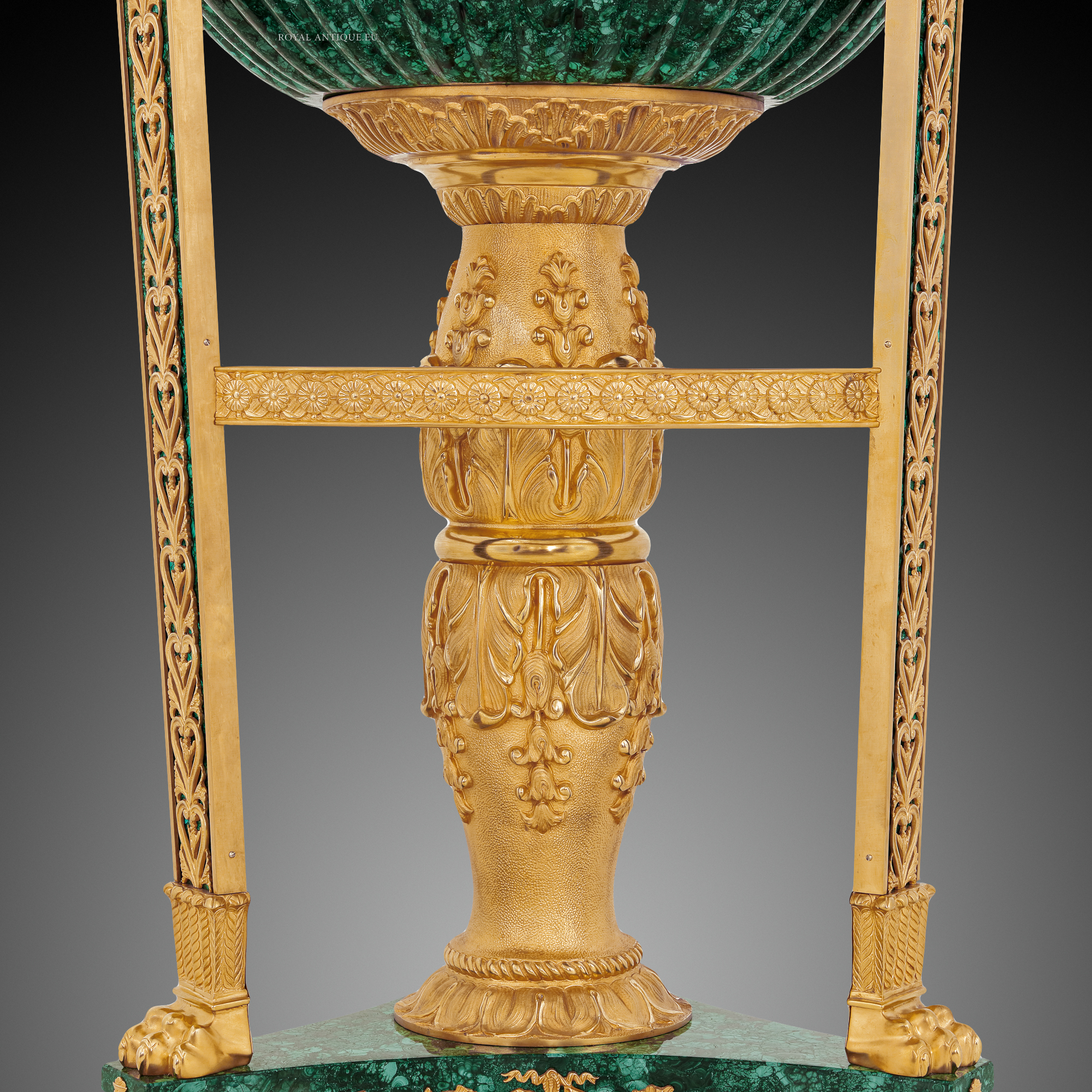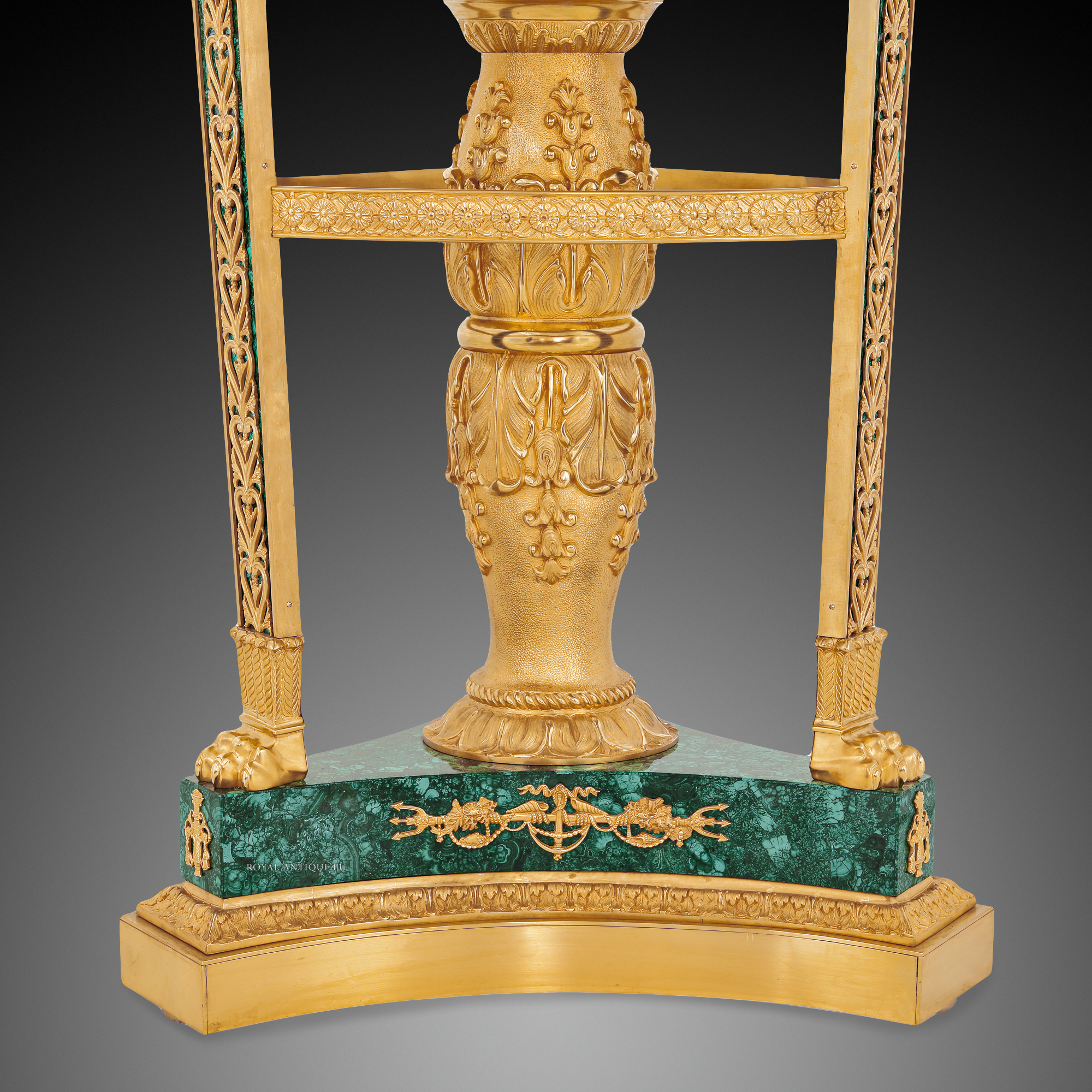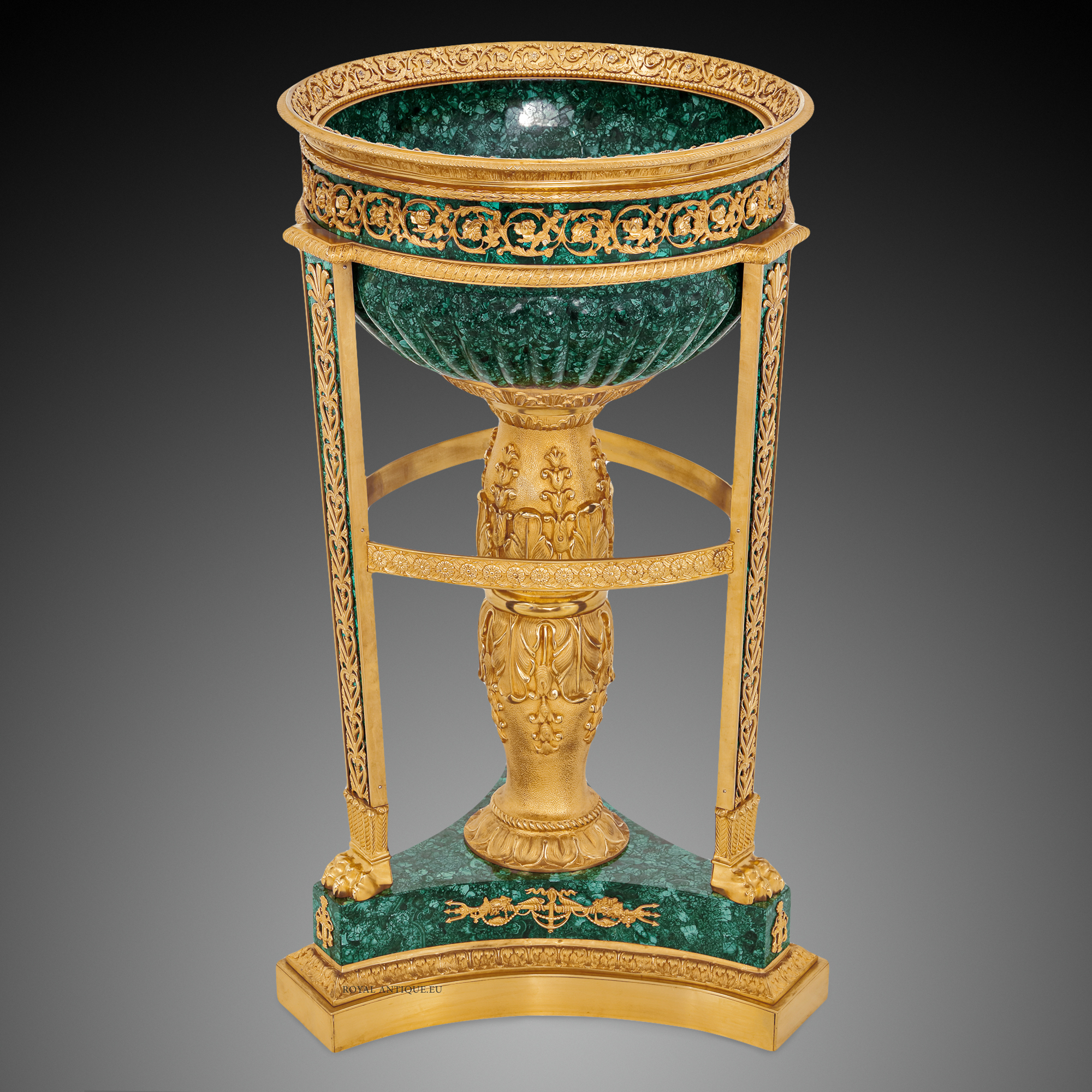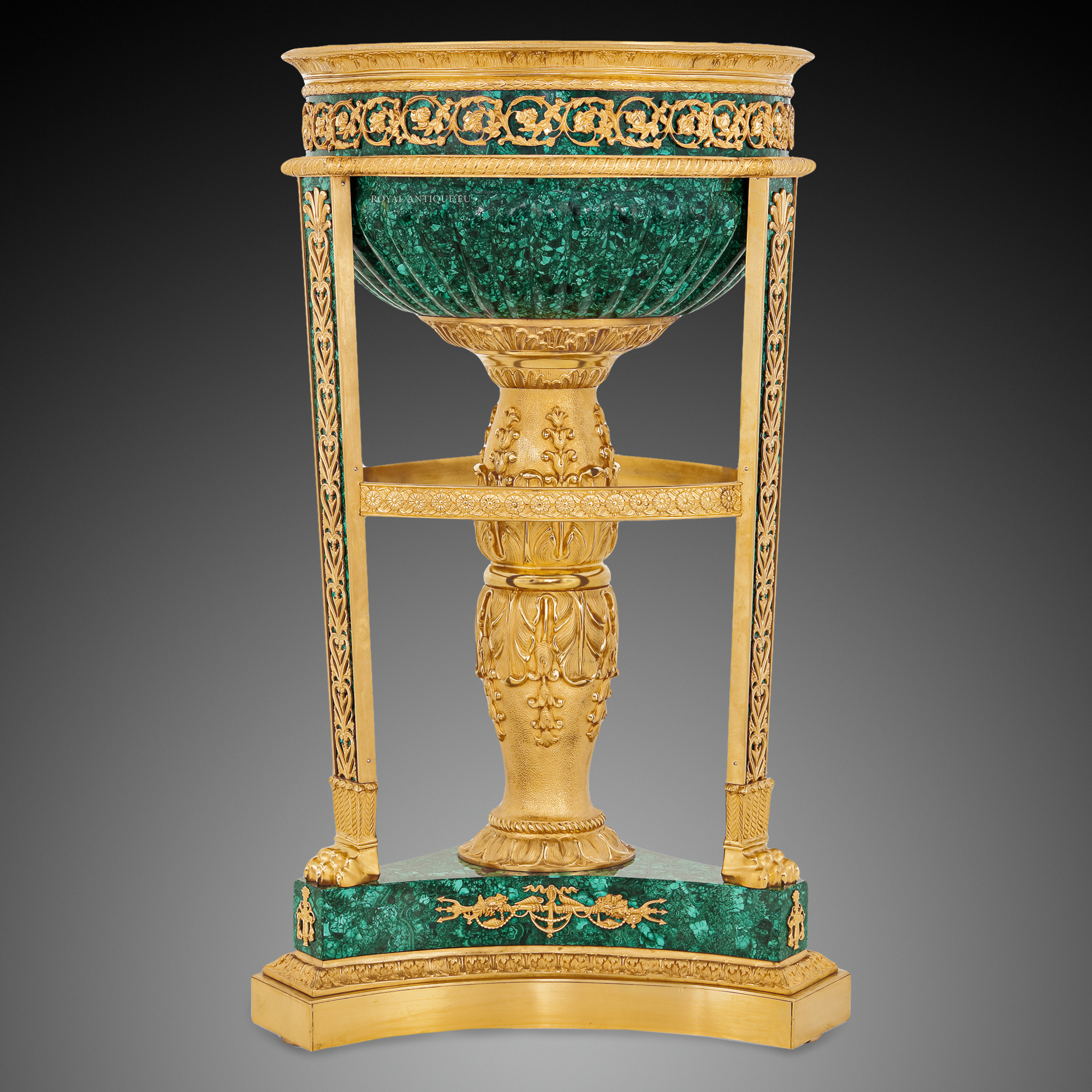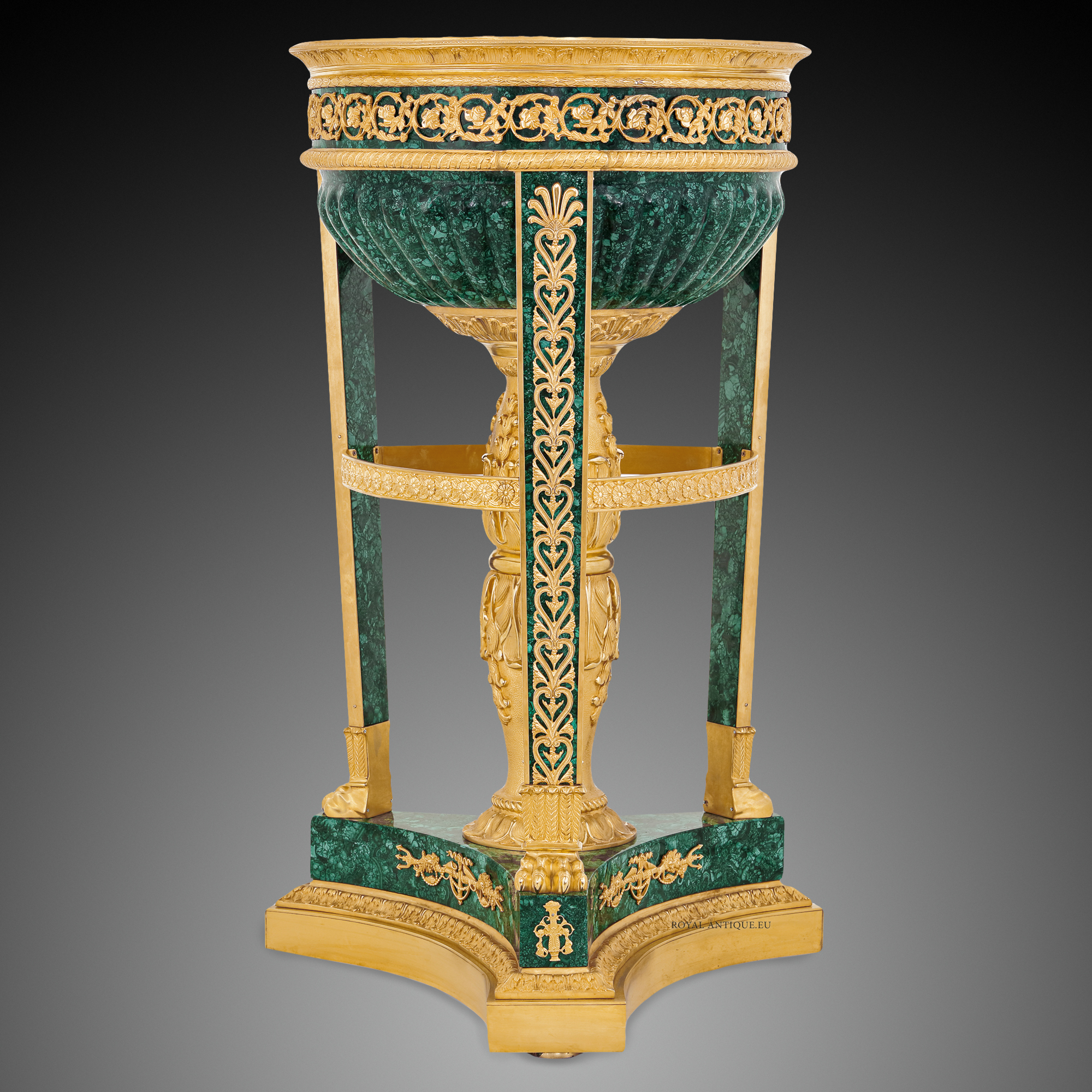
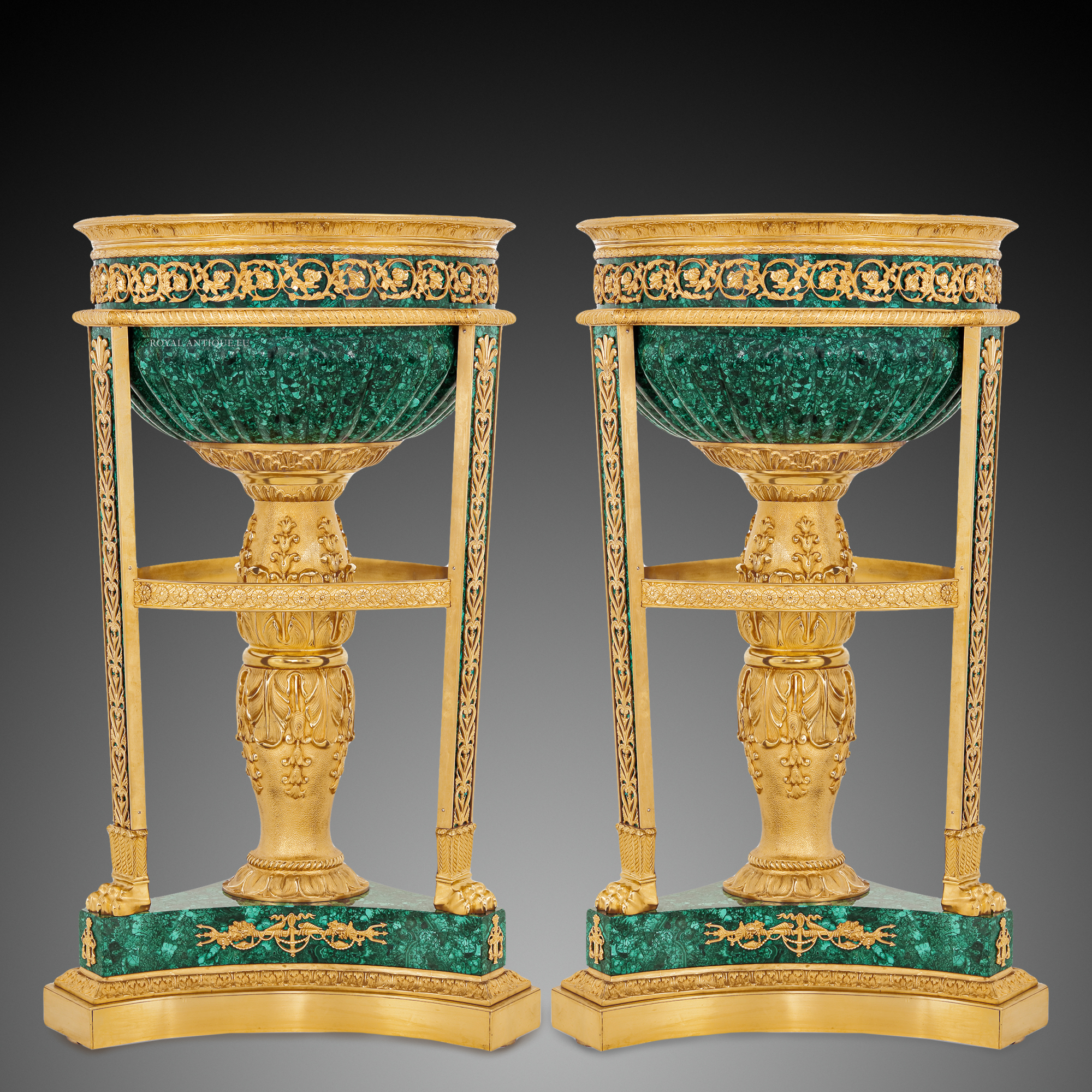
Pair of Athenian in the style of Thomire made of chiseled brass plated with 24 carats gold and cover with malachite stone. 3 legs and a central pilar supporting the malachite basin.
History of pair of original Athenian of Pierre-Philippe Thomire (1751-1843)
gilt bronze, hardstones
Catalogue Note
This model was created by Thomire after designs by Percier and Fontaine and incorporated into an ormolu and cut glass surtout de table commissioned by Louis XVIII. This surtout, comprising fifty-seven pieces, was first exhibited at the Louvre’s 1823 Exposition des produits de l’industrie and then in the same year in the Exposition des produits des manufactures royales. One of the athéniennes can be seen in a contemporary depiction of the former exhibition (see illustration). A smaller single athénienne of this model by Thomire executed entirely in ormolu was sold Christie’s London, December 14, 2000, lot 148.
The tripod-vase form athénienne was disseminated by Giovanni Battista Piranesi through his celebrated Vasi, candelabri, cippi, sarcofagi, tripodi, lucerne ed ornamenti antichi published in Rome in 1778. Although late eighteenth-century interpretations of this form exist, athéniennes became increasingly more fashionable during the early years of the Empire period, when they were adapted as the preferred shape for washstands, braziers and centerpieces. This new popularity was largely due to Charles Percier and Pierre Fontaine’s different interpretations of the tripod-vase form in their Recueil de décoration intérieure. In fact, an athénienne depicted in Percier and Fontaine’s iconic publication has the same tapering legs, gadrooned tazza-form top and a central baluster support as the present lot. However, Percier and Fontaine’s work was not the only direct influence on the design of these athéniennes, as a drawing by Piranesi from his abovementioned publication shows a tripod-vase with similar circular stretchers and identical paw feet raised on a plinth. Although the overall design is inspired by the above draughtsmen, Thomire embellished these athéniennes with his own preferred decorative elements such as the central inverted double balustrade support and the oak leaf pattern. The former can be seen in a centerpiece stamped Thomire à Paris and now in the Victoria and Albert Museum, London, see Hans Ottomeyer and Peter Pröschel, Vergoldete Bronzen, Vol. I, Munich, 1986, p. 387, fig. 6.16.12, while the latter in a tazza also signed by Thomire, see ibid., p. 386, fig. 5.16.10 and a massive pair of ormolu torchères by Thomire at Versailles, see Pierre Arizzoli-Clémentel and Jean-Pierre Samoyault, Le Mobilier de Versailles: Chefs-d’oeuvre du XIXe Siècle, Dijon, 2009, pp. 262-263.
Most of Thomire’s decorative objects are executed in ormolu, patinated bronze and marble with the occasional cut glass embellishment. Larger pieces incorporating malachite by Thomire seldom appear on the market. A pair of ormolu and malachite tazze of comparable size signed Thomire à Paris from the collection of the Corcoran Gallery of Art, Washington, D.C., was sold Sotheby’s New York, June 3, 2008, lot 139 ($194,500). Malachite was a costly and much-treasured material in France during the first quarter of the nineteenth century as it was usually imported from the Siberian mines of the Russian Empire. Objects and furniture incorporating malachite, porphyry and other exotic hard stones were considered extremely luxurious and thus it is not surprising that such pieces were also used as diplomatic gifts, as it was the case in 1808 when the Russian ambassador count Tolstoi presented Napoleon on behalf of Tzar Alexander I with such pieces.
Pierre-Philippe Thomire (1751-1843)
Thomire was the most outstanding fondeur-doreur of the Empire period. Thomire worked as a ciseleur under Pierre Gouthière in 1774 and collaborated in the decoration of the coronation coach of Louis XVI in 1776 and set up on his own in the following year. He is known to have supplied mounts for furniture by the most celebrated ébénistes of the time such as Beneman and Weisweiller. Thomire was a favorite of Napoleon who made him ciseleur de l’Empéreur. In 1811 he collaborated with the goldsmith Odiot and made the celebrated cradle for the King of Rome. During the Restauration period he worked for the Bourbons and was awarded the Légion d’Honneur by Louis-Philippe. He retired in 1823 but his firm Thomire et Cie continued until 1850.