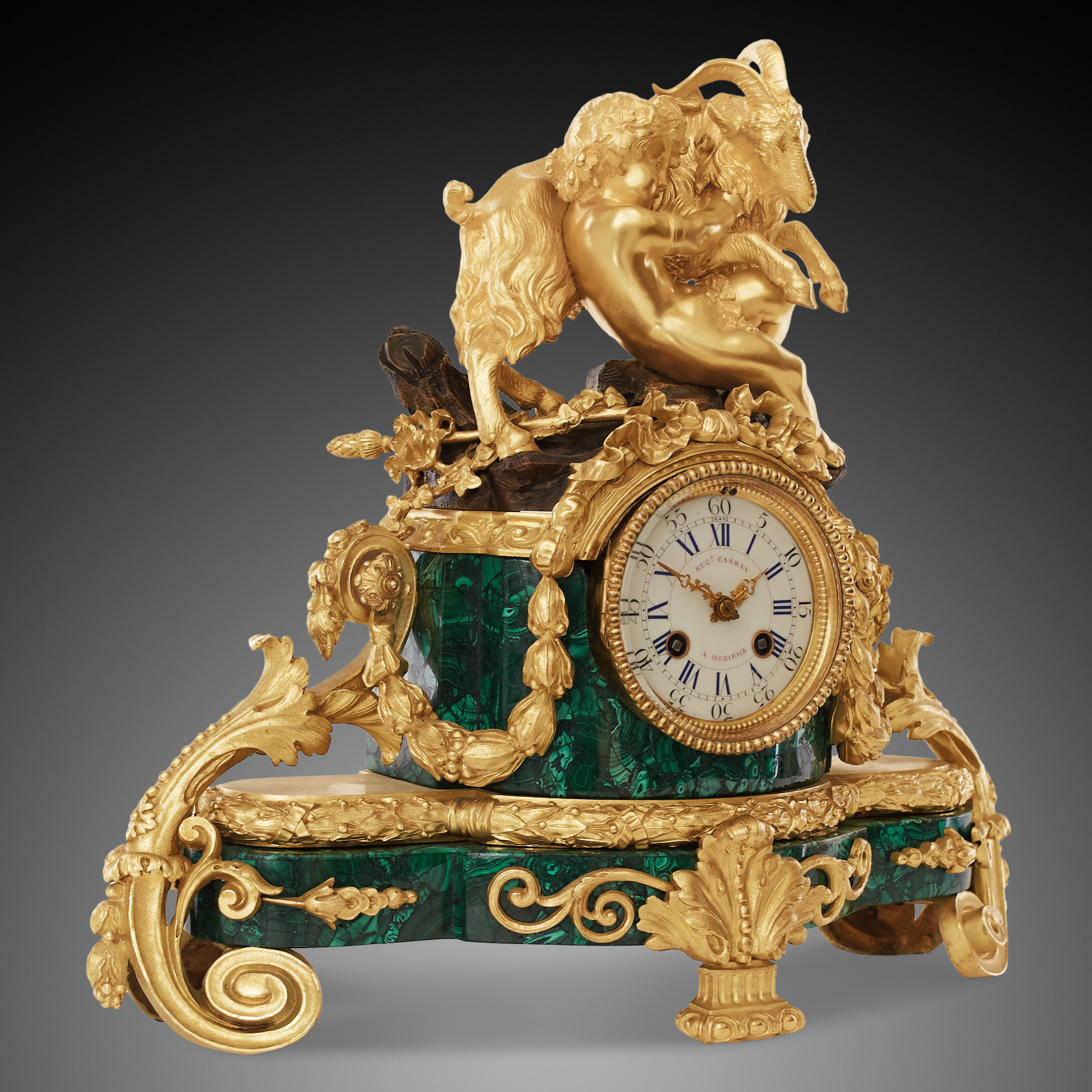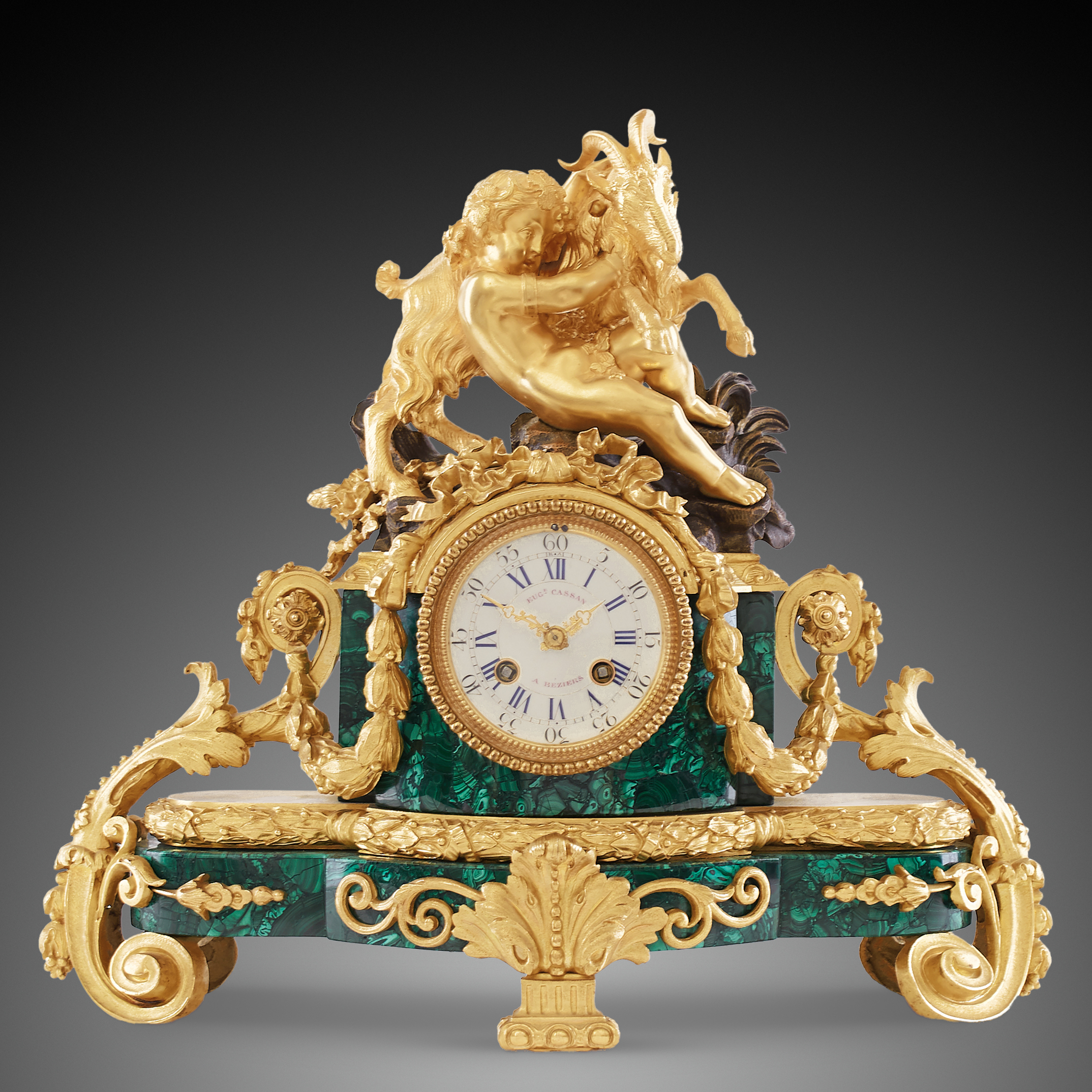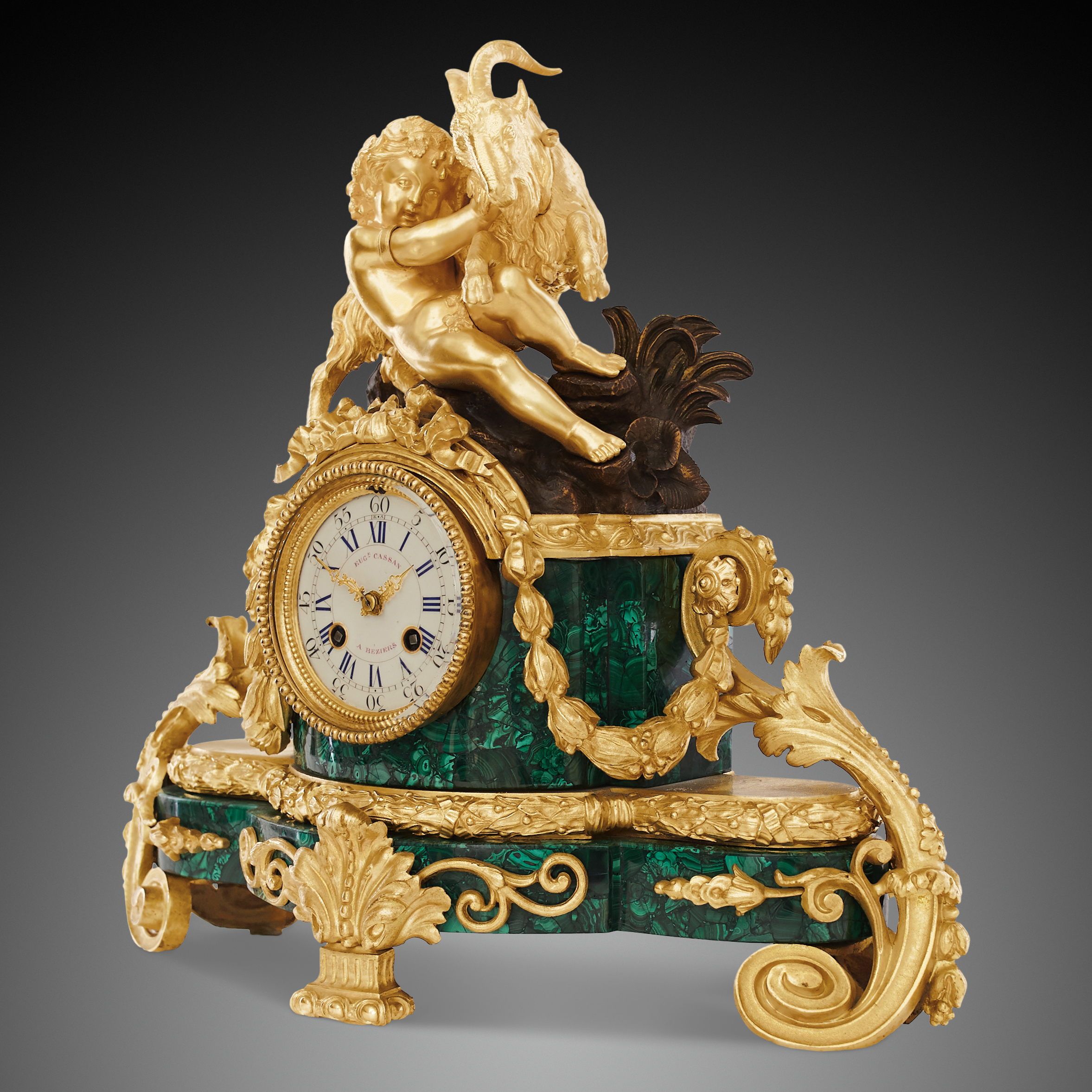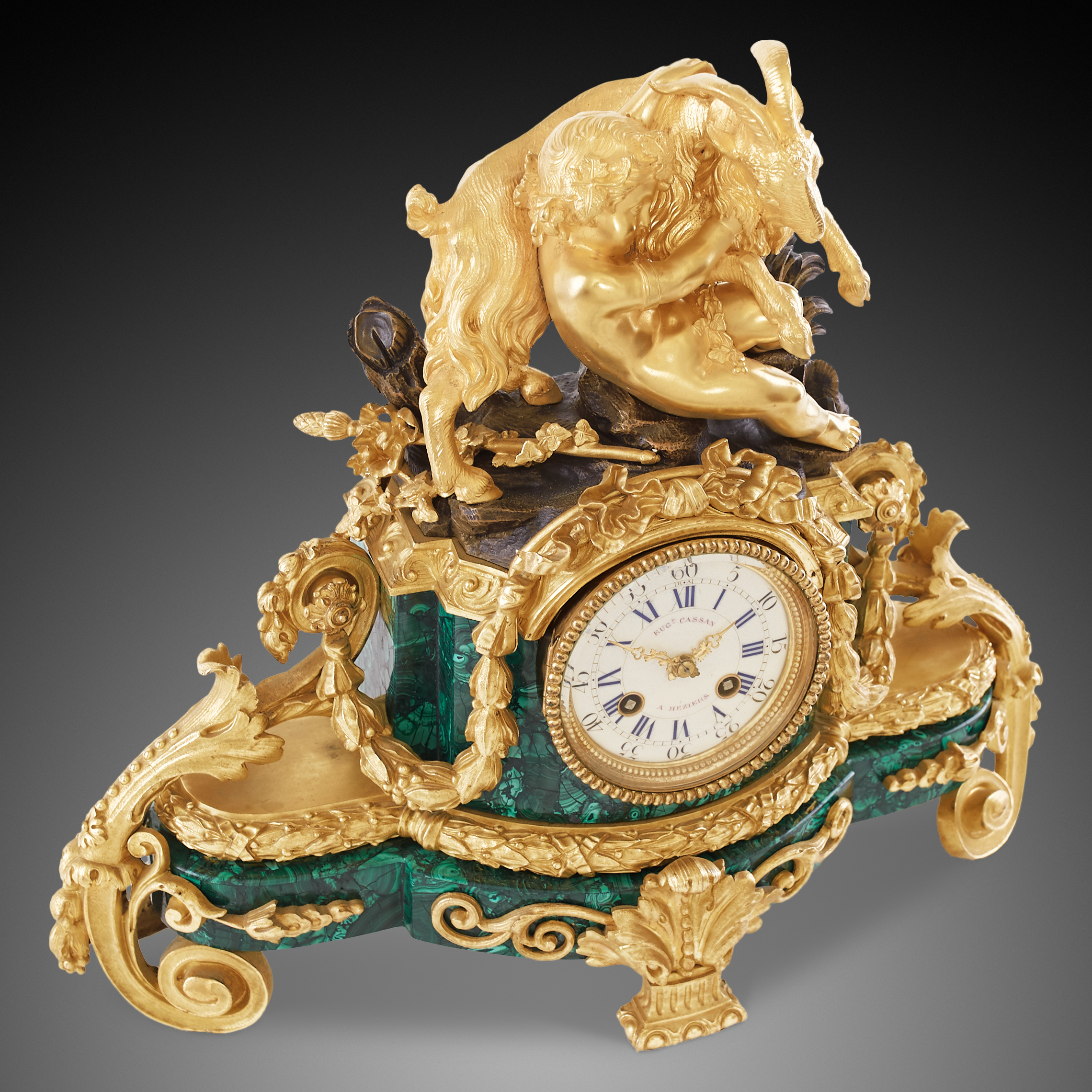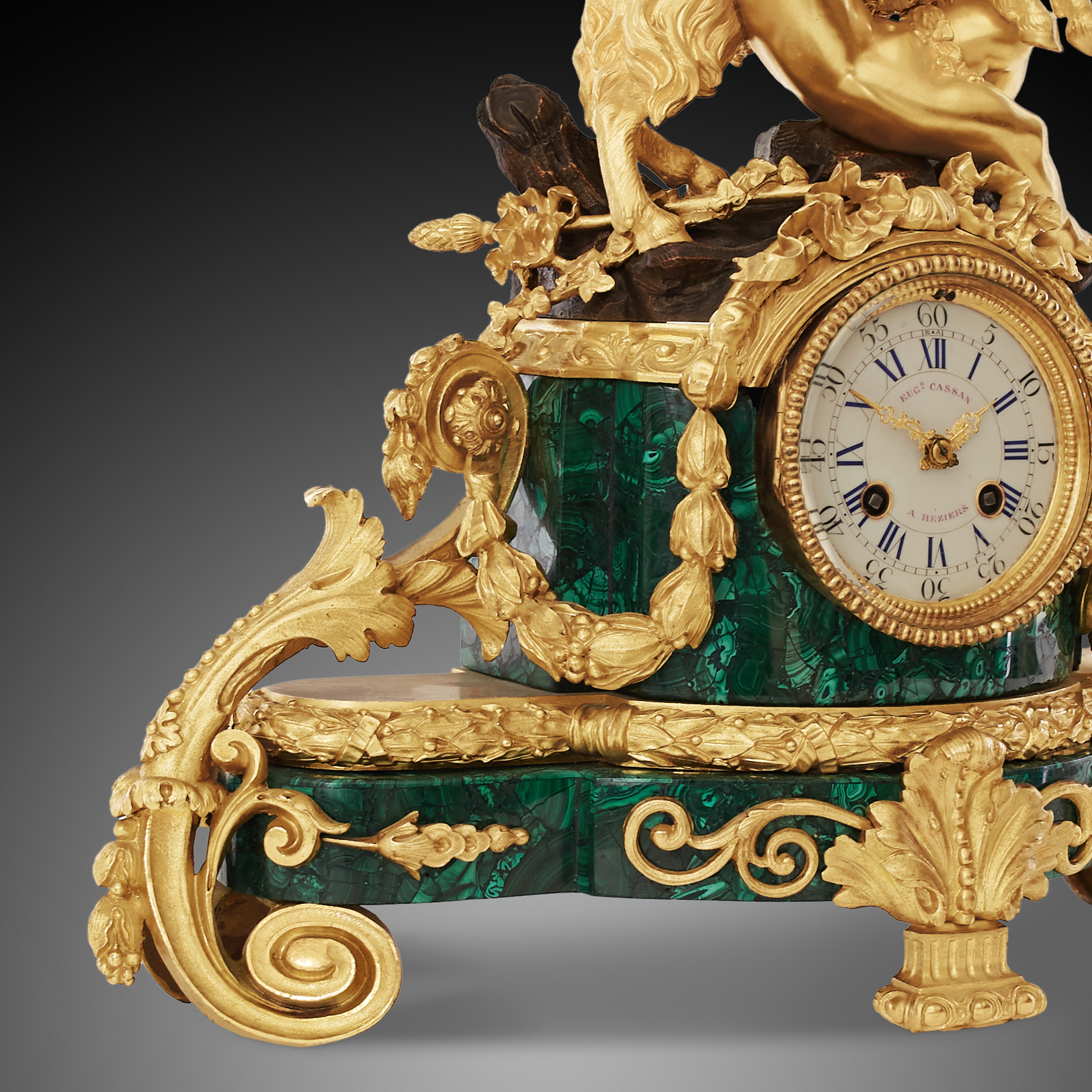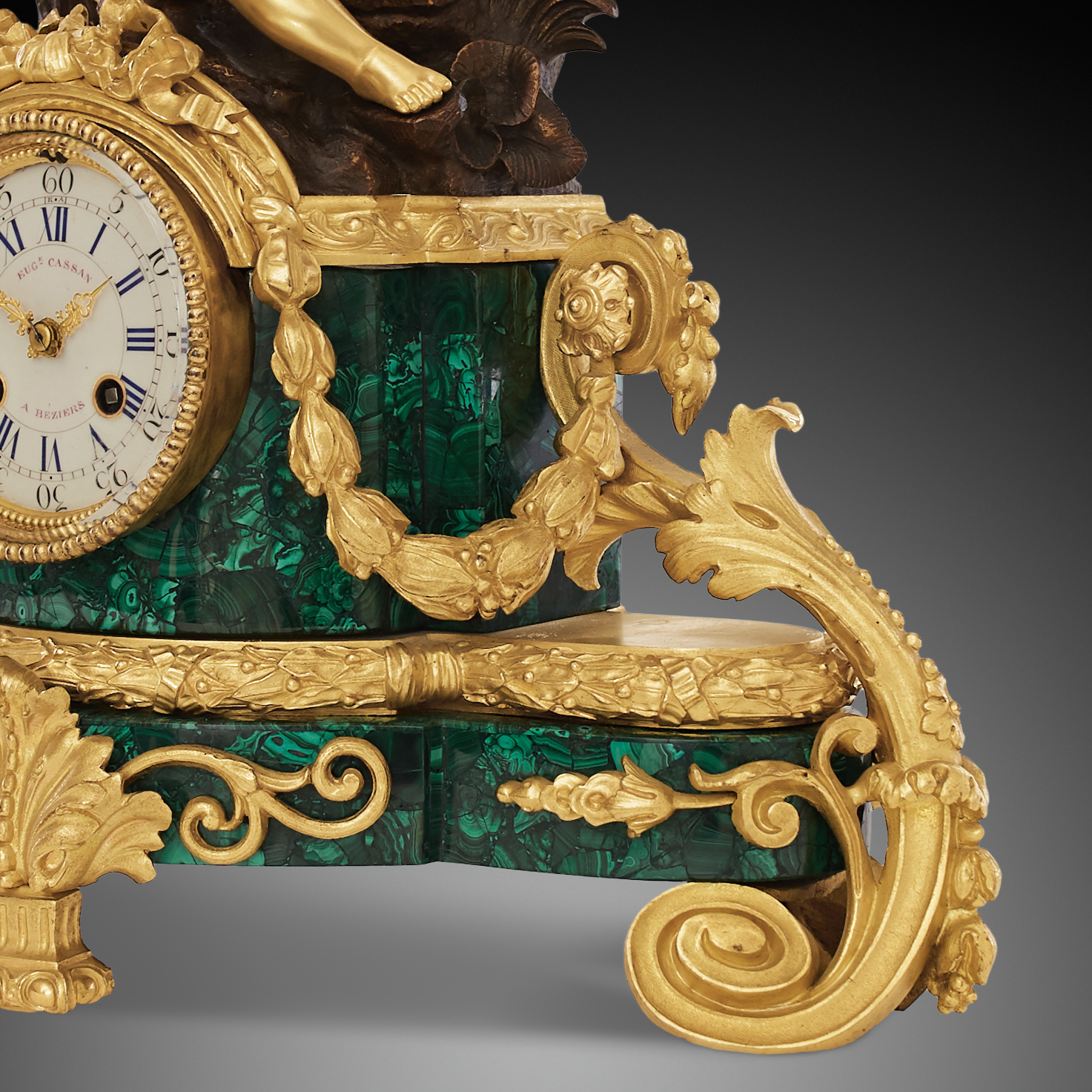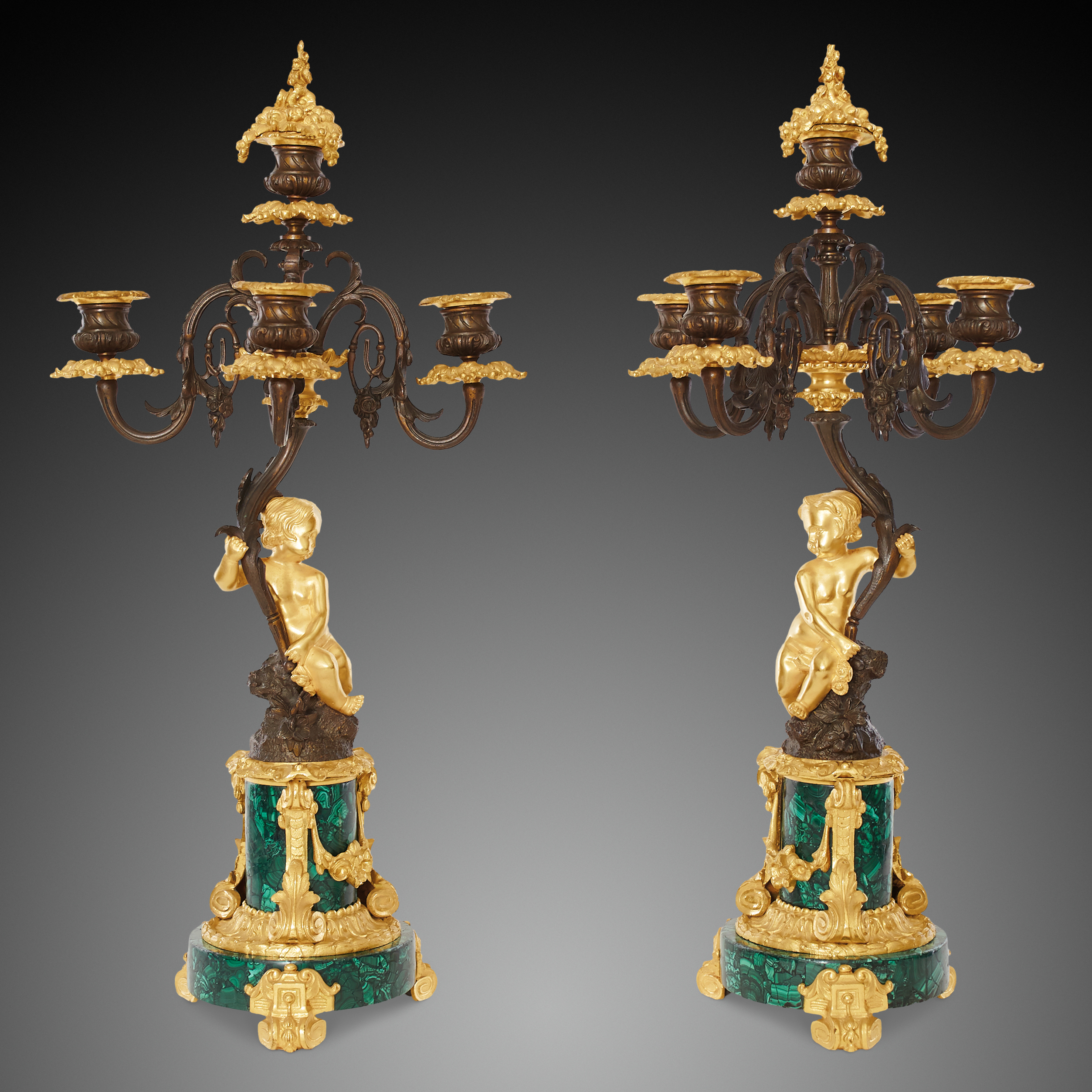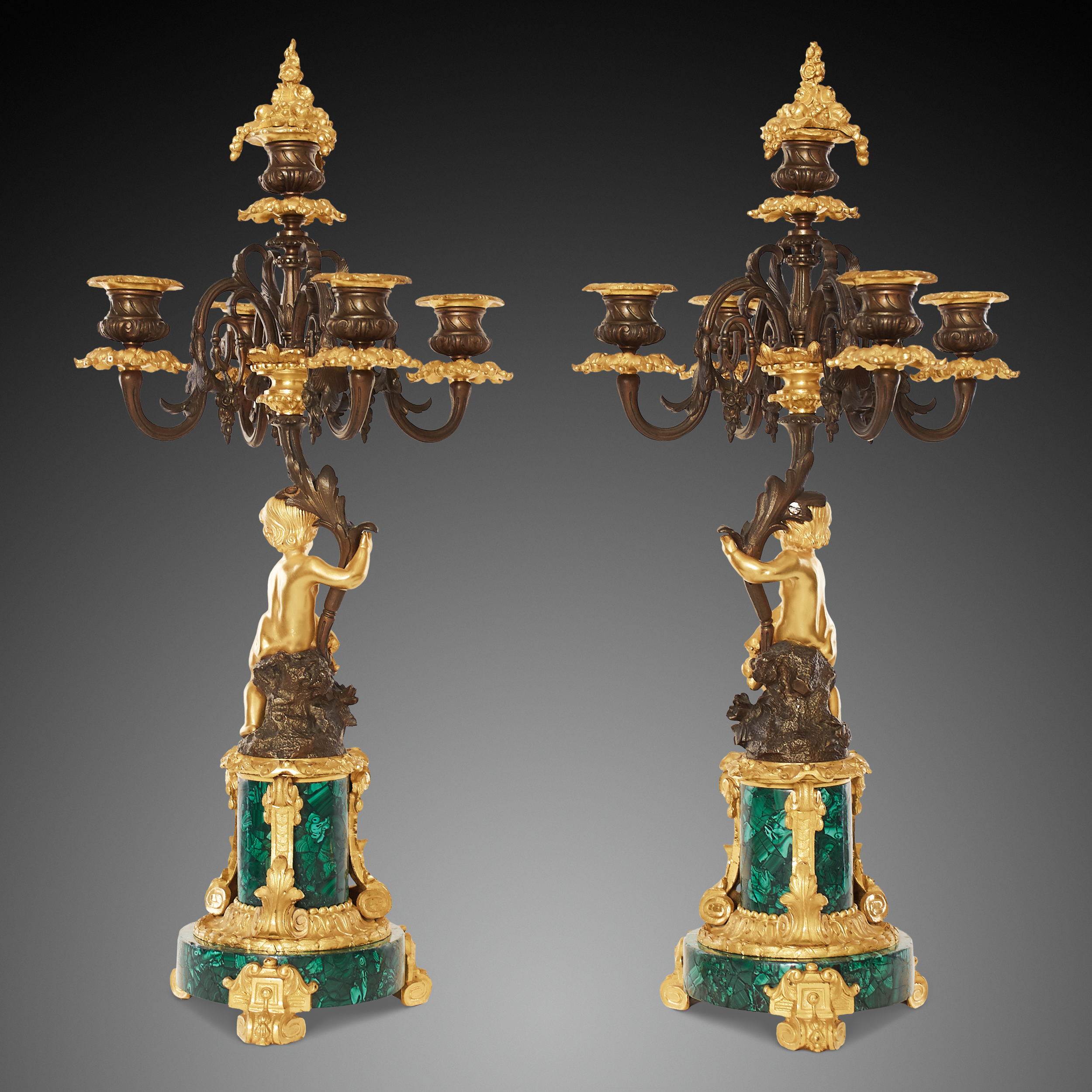
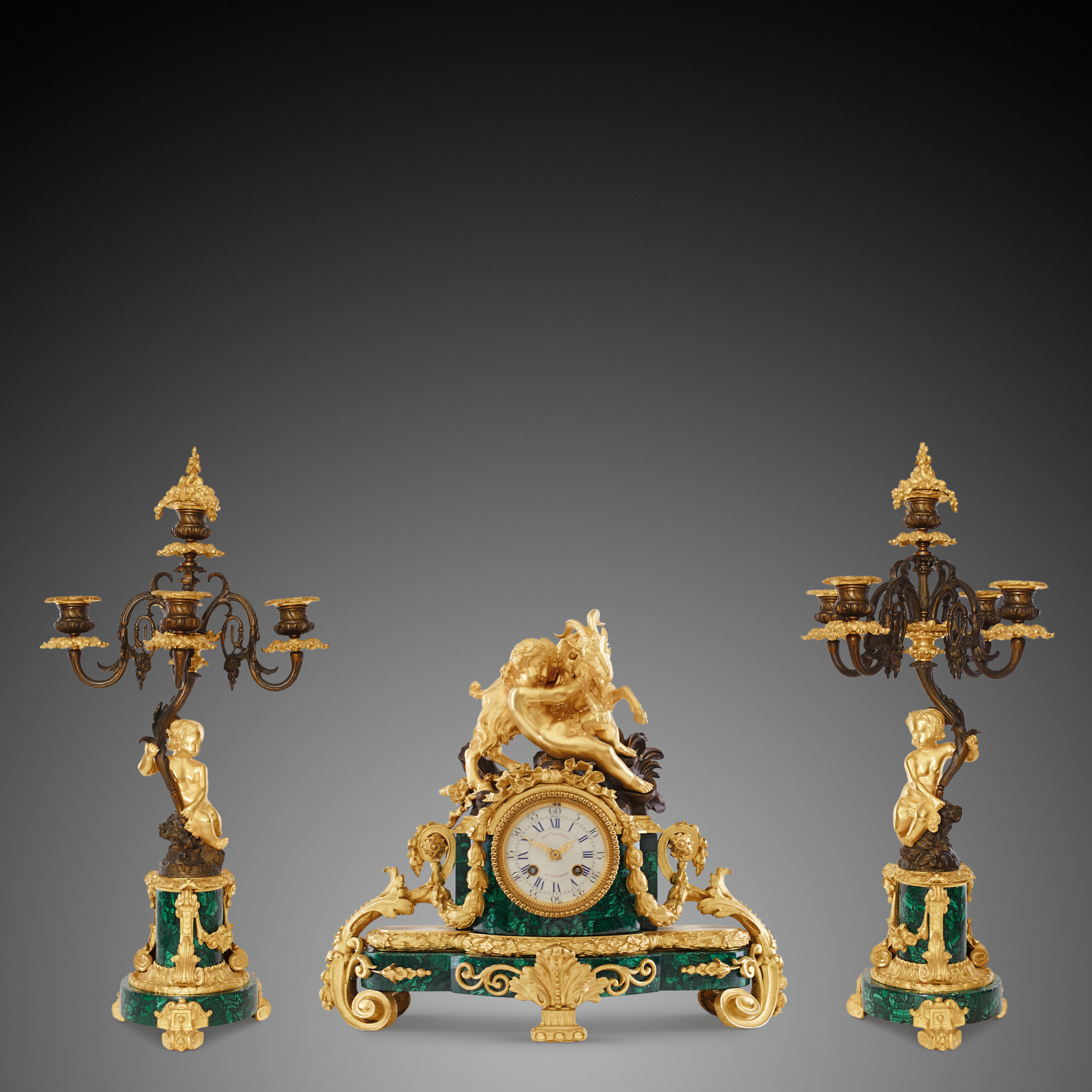
This extraordinary 19th-century French mantel garniture, comprising a stately central clock and a perfectly balanced pair of four-light candelabra, represents the absolute zenith of Second Empire luxury and decorative ambition. The entire ensemble serves as a masterful synthesis of rare, precious materials and high-narrative sculpture, drawing deeply from the Rococo and Neoclassical influences that dominated the most refined interior design schemes during the reign of Napoleon III. The foundation of this set is defined by the strategic and lavish use of vivid, intense green malachite, a semi-precious stone prized not only for its striking, kaleidoscopic color and complex, swirling banding but also for its extreme rarity. In 19th-century France, such malachite was frequently imported at great expense from the Russian Urals and was universally recognized as an unassailable symbol of immense wealth and social status, as the inherent difficulty of working such a brittle stone into smooth, seamless veneers required a level of lapidary skill found only in the most elite workshops.
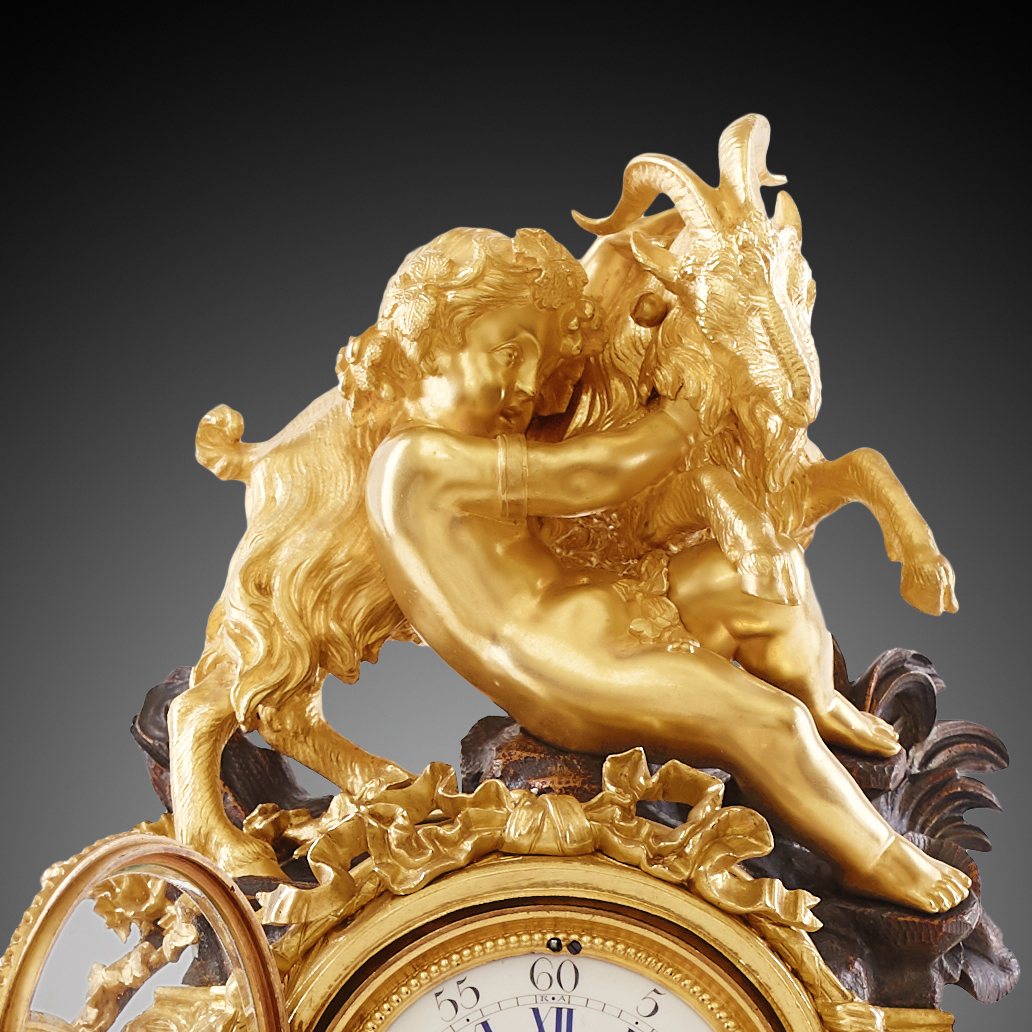
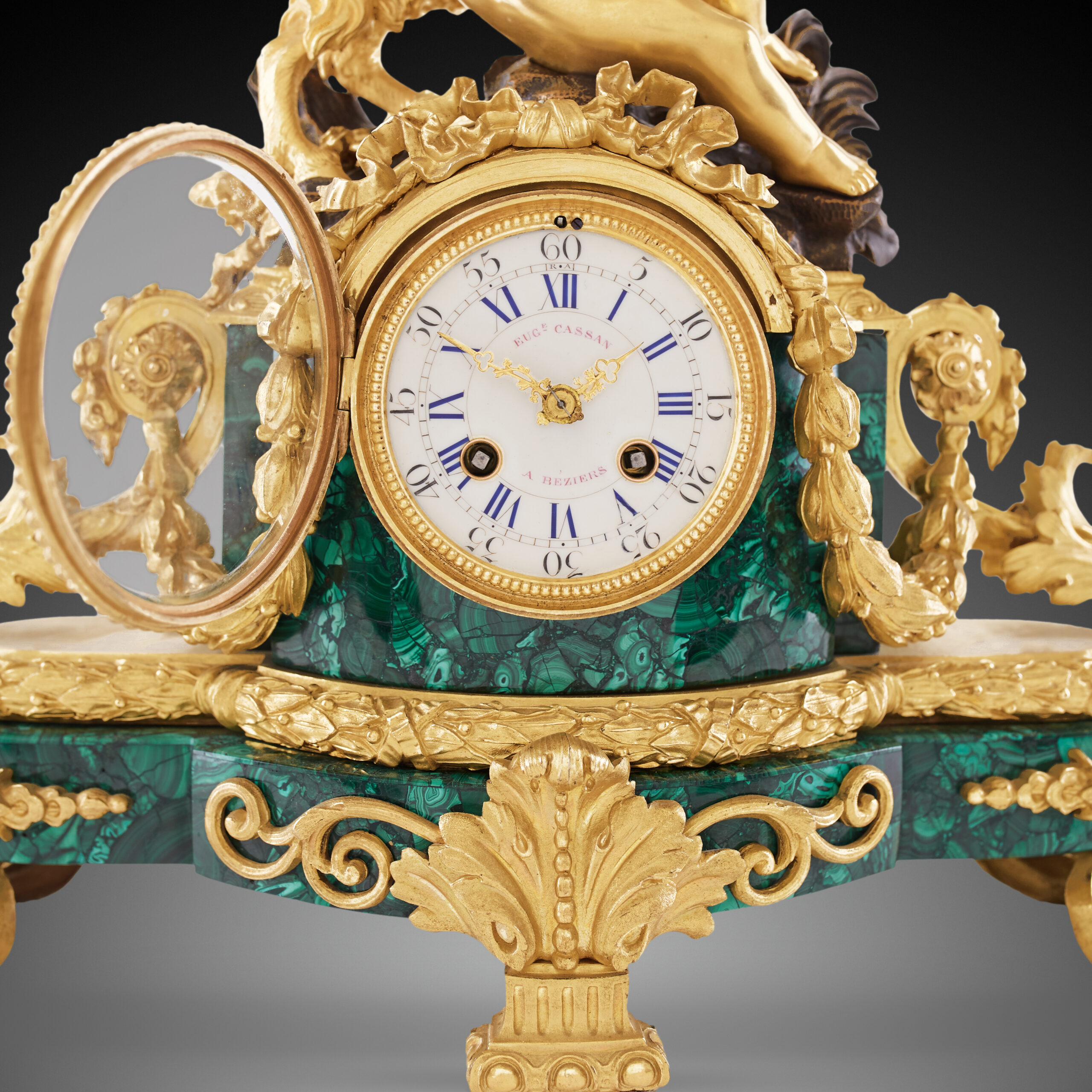
The malachite provides a cool, profound contrast to the heavy, opulent application of finely chased mercury-gilded bronze, or ormolu, which blankets the composition in brilliant gold. Each individual gilt-bronze element exhibits a remarkable degree of artisanal precision, from the sophisticated, dynamic musculature of the central mythological figures to the delicate, rhythmic texture of the sweeping foliate scrolls and acanthus-leaf motifs. The central timepiece is anchored by a sculptural group of extraordinary vitality, likely depicting a classic mythological bacchic revelry, where the fluid, interlocking forms of the figures add a sense of intense, baroque movement to the otherwise stable architectural base. The dial, featuring crisp white enamel and elegant Roman numerals, carries the signature of the master horloger, ensuring its mechanical pedigree and status as a functional precision instrument.
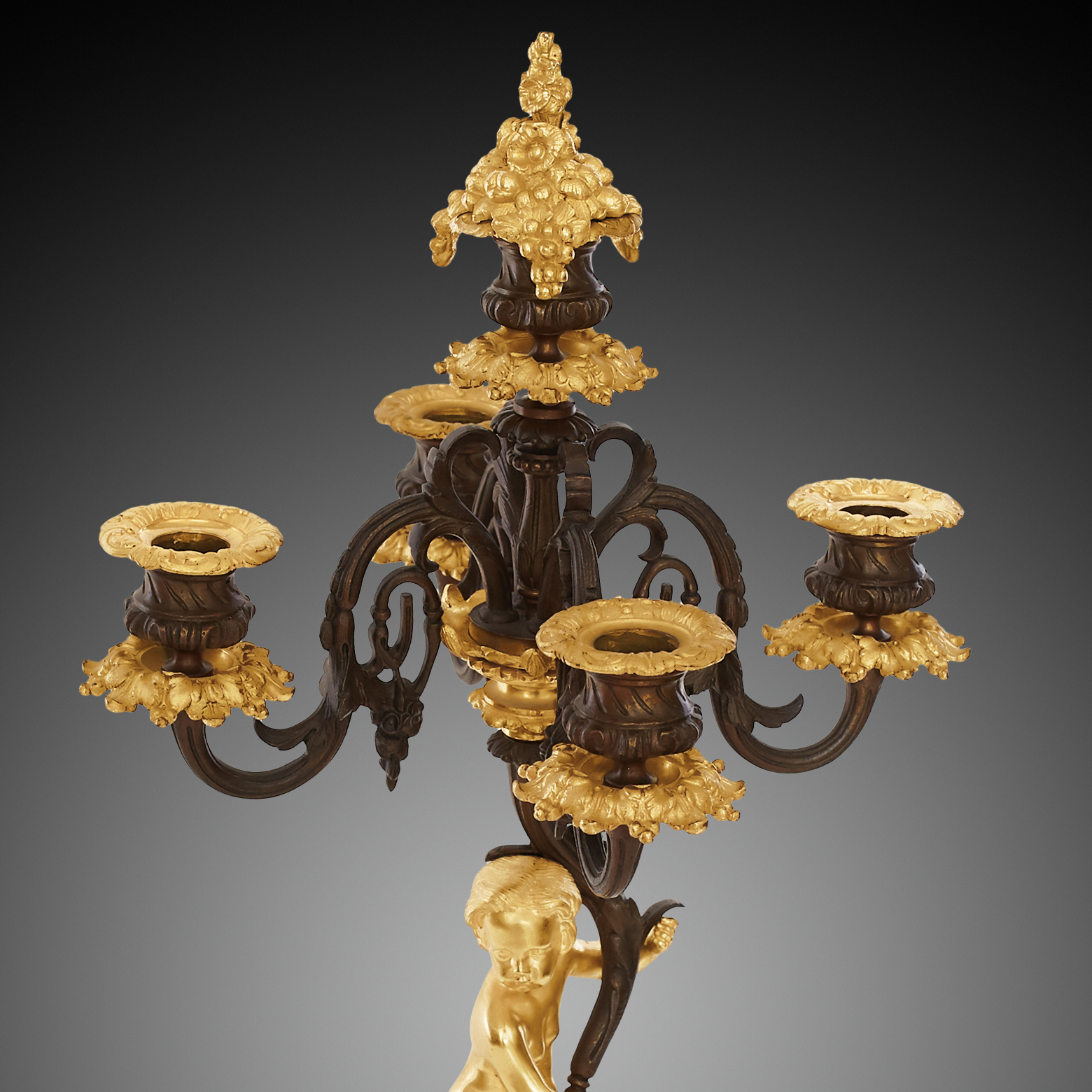
The flanking candelabra perfectly mirror this narrative intensity, with exquisitely cast patinated and gilt-bronze putti-classically inspired winged figures-expertly climbing spiraling vines that terminate in four ornate candle nozzles. These figures, set upon cylindrical malachite plinths enriched with ormolu swags and intricate acanthus-leaf feet, demonstrate a sophisticated tonal hierarchy that masterfully balances the dark, atmospheric patina of the vines against the brilliant, reflective quality of the gold. Historically, such a garniture was designed specifically for the grandest salons of the European aristocracy, serving as the definitive, immovable focal point of a fireplace mantel. During this period, the arrangement was far more than a mere collection of decorative objects; it was a carefully curated, public statement of refined taste and historical eclecticism that signaled the owner’s cultural literacy.
The production of this set required the seamless, highly coordinated efforts of several distinct and specialized ateliers: the fondeur-ciseleur for the complex casting and chasing of the bronze, the doreur for the perilous and exacting process of mercury gilding, the marbrier for the precision cutting and polishing of the stone, and the master horloger for the intricate, reliable movement. This multidisciplinary mastery allowed 19th-century artisans to elevate functional domestic furnishings to the level of monumental, museum-quality sculpture, effectively preserving the enduring, legendary grandeur of French courtly life for a new age of industrial and political power. The ensemble stands today as a profound testament to an era where decorative arts were engineered to function as both a precise timekeeping instrument and a significant architectural statement intended for the most discerning and sophisticated interiors, serving as a tangible bridge between the artistic traditions of the past and the industrial achievements of the 19th century.
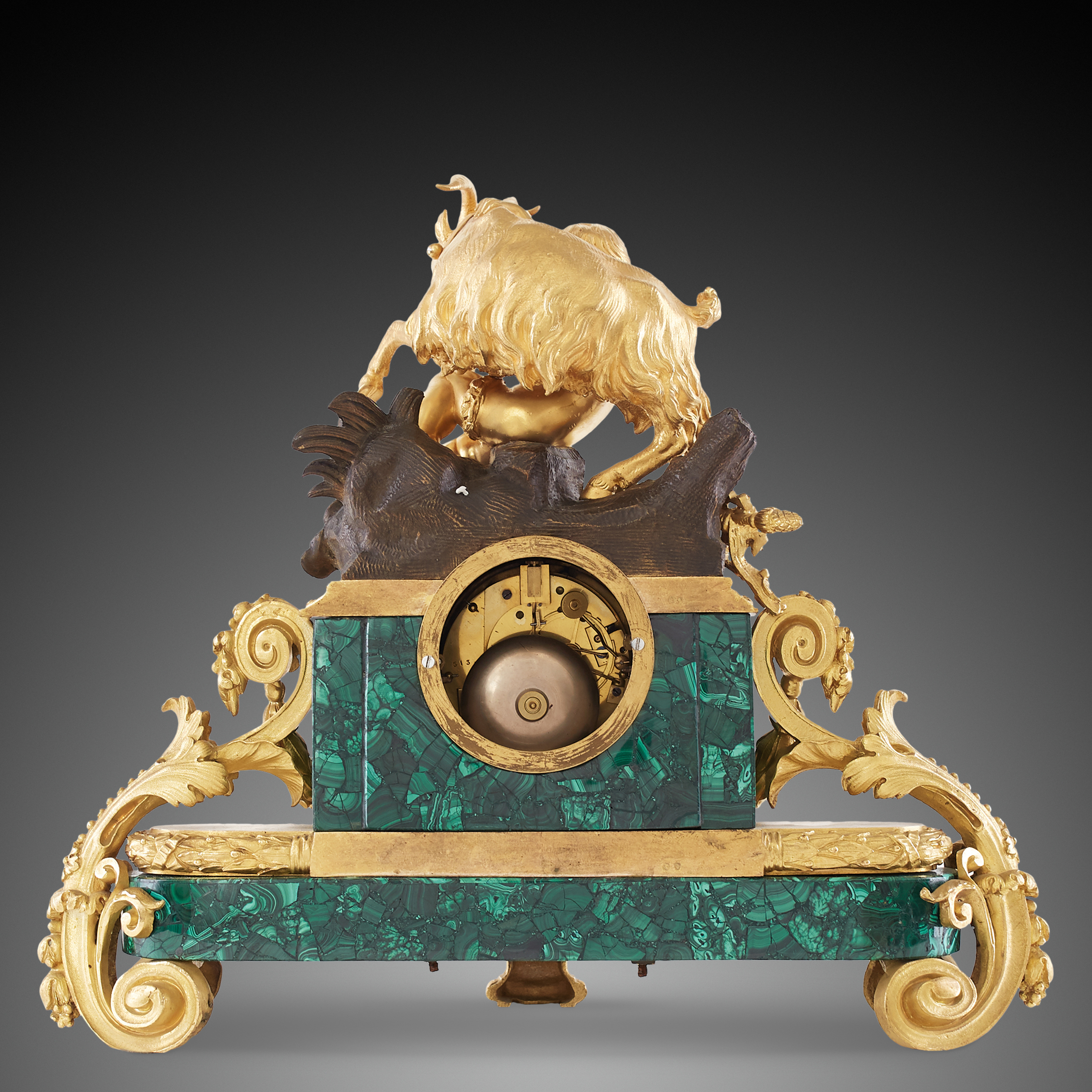
Details of the movement mechanism: Eight days there is a pendulum hanging. He struck an hour and a half on the bell. The clock is working great and tot. And it was recently cleaned and serviced by a professional clockmaker. The clock is delivered complete with, key and bell.